BOOK PURCHASE: Discount (above) or PayPal (below)
Click "Buy Now" to continue to PayPal
Click to order eBook - Kindle

Click to order eBook - Nook

Oct
20
PTSD Suffering & Control
Filed Under PTSD, Trauma, Treating PTSD | 1 Comment
By Janet J. Seahorn
This may be one of the most important blogs that I have written. Important because we are quickly becoming a people who, due to the recent attention on Post Traumatic Stress, are beginning to lump into the same basket all vets who return from conflict challenged by PTSD.
This is a major dilemma. It is vital that we as a nation, as communities, and as families start to have a more accurate description of the effects of combat trauma. Important because without correct information, we cannot help to mend the minds, hearts, and souls of those who suffer.
For that reason, solid facts through research on PTSD lead to better care. The problem, however, occurs when the media focuses only on those individuals who behave in extreme ways. Ways that make news casts, papers, and internet reading more exciting.
For the vast majority of veterans who return from combat tormented by the memories of war, the battle is within and remains there, silently distressing the individual.
But here is what is key to remember; the majority of vets are not personally or professional “out of control”. In fact, they spend a tremendous amount of time and energy trying to remain in control. For many, the periods of distress are when the person is alone, safe within the confines of house and home, or experiencing a severe physical or family crisis.
For most, the only people who see the anxiety and panic are not the outside world, but rather those within the vet’s inner-most circles: spouses, children, siblings, parents, and very close friends.
There are already many young (and some older vets) who are refusing to acknowledge they have a problem, or seek medical interventions even when they realize they need it. And why would they? Fearing they will be labeled and thrown into that “media basket” of dysfunction, they prefer to maintain a mask of silence. This isn’t acceptable, nor is it effective in mending the situation.
Yes, PTSD is a reality for many in our world, not just combat vets. For sure, it is a challenge like any “reordering” of the mind and body. Yet, most individuals move forward to live productive, successful lives. And if the individual gets appropriate medical and professional attention, that life and those who are closest to him/her, the living becomes immensely easier.
So let’s begin to write and tell stories of these quiet, courageous men and women. Stories of heroes and heroines who survive and manage to prosper in many areas of their lives; appreciating the fact that to be a hero requires an extraordinary act of bravery within an ordinary human spirit.
Oct
7
Coming Home
Filed Under American Patriotism, Life, PTSD, Today's War | Comments Off on Coming Home
by Stars and Stripes

He’s a businessman now. He has leisure time. He reads his law books, looks for a house to buy. He sleeps on clean sheets, and takes Hawaiian cruises with his family.
But a part of Dave Johnson is still in Iraq.
A couple of times a week, he wakes up there – “in the middle of a giant explosion,” he said, like the one on his second tour that took out his patrol base, killed one colleague, maimed another and injured a dozen more.
The former sergeant, who enlisted after getting a law degree to do his duty for his country – then was stop-lossed for 18 months – revisits the battleground in his waking life, too.
Every now and then, he says, he’ll have a flashback – “a very, very vivid memory” – of one among six or so events during his first Iraq tour.
A certain suicide bombing in a market, for instance.
“It was the last one I ever went to. We were the first responders,” Johnson, 30, said. “I felt the concussion. The blast wasn’t as big so there were much larger body parts, an arm here, a leg …
“It was me and Capt. [Matt] Lee and a member of the British Parliament. The entire market burned to the ground,” he said.
The memories creep in without warning, he said, and the acute flashback, including increased pulse and perspiration rate and a pounding heart, lasts about 30 seconds. Johnson’s twin brother, who spends a lot of time with him teaching him the family roofing business, can tell when it happens.
“He says, ‘You’re twitching again, dude.’
So Johnson wasn’t surprised to be diagnosed with post-traumatic stress disorder. The nightmares, the residual feelings of terror, the loss of sleep – all of it “affects you all day,” he said. And to have a flashback in the courtroom would not be good, he said.
Experts estimate that fully 20 percent of Iraq-deployed troops have developed PTSD and that nearly all show some post-combat anxiety. Yet despite a Defense Department effort to remove the stigma surrounding such psychological impacts of combat, many soldiers are still hesitant to admit they may be having problems and seek help.
Now Johnson spends his days learning the family roofing business from his brother. He’s looking for a starter house. Evenings he reads up on civil law so he can assist with the firm’s legal work.
Life is good, he said.
Yet as glad as he is to be out, he has few regrets about having been a grunt.
“Riding in a helo, staying up for 50-some hours straight, carrying a machine gun … I wouldn’t have traded it for the world.”
Sep
29
by Janet Seahorn

Have you ever heard a song a hundred times and never thought much about it?
Then one day, you are driving down the road with nothing to obscure your mind; you hear this very same song and it suddenly hits a new note, a new way of thinking about the words, and you wonder why did I never recognize the amazing connection?
Such an incident came to me a week ago while I was steering down the highway. I heard a song from Josh Groban’s album, Awake, called “Weeping”. What took me by surprise was how closely the words seemed to describe the silent torment of trauma.
How experiencing a truly shocking event, the mind, body, and spirit continues to relive the disturbing details as if they were happening in present time.
How, no matter what you try, how much you do to contain or remove the frightening thoughts, they still seem to remain.
The words from the song “Weeping” is another way to describe those living with Post Traumatic Stress. See if you agree – I only wrote down a verse and the poignant chorus.
I knew a man, who lived in fear,
It was huge, it was angry, it was drawing near.
Behind his house a secret place
Was the shadow of a demon he could never face.
He built a wall of steal and flame
And men with guns to keep it tamed…
It doesn’t matter now,
it’s over anyhow,
He tells the world that it’s sleeping.
But as the night came out
I heard a lonely sound
It wasn’t roaring, it was sleeping.
So where are those “secret” places where the demons hide? And, even more important, how many sufferers are strong and courageous enough to face them, deal with them, and move forward?
For there are no walls high enough, no amount of men with guns that will be able to tame one’s internal demons.
In the end, perhaps the residue of trauma isn’t fueled by fear and anger at all; perhaps what remains is fueled by a sense of deep sorrow. A sorrow provoked by dreams of what could have been. Sorrow from what was lost and the silent weeping formed from loneliness and regret.
And perhaps, with enough time, enough support, and enough courage even the weeping will cease and be replaced with hope and joy.
Sep
23
The Teeter Totter Journey
Filed Under Life, PTSD | 2 Comments
 by Janet Seahorn
Ever think of life as a “teeter totter journey”? Sometimes you’re up, sometimes your down, and when everything is in perfect balance, you are somewhere in-between.
The biggest challenge on a teeter totter is keeping that perfect balance. The certainty of teeter tottering is that equilibrium doesn’t last very long. As soon as the tiniest shift occurs on either side, the mechanism moves.
When you were a child playing on the teeter totter, the fun wasn’t keeping the slab of wood in balance; it was the fast ups and downs as you tried to give your partner a very exciting ride.
Life is a bit like that teeter totter. Some days we are up, some days down, and, every so often, we are within the perfect balance. If we really examined it, however, we would notice that most of our time is spent in the process of moving between the ups and the downs.
This is not good or bad. It just is. Post-Traumatic Stress can be life’s ultimate teeter totter. The ride is faster, quicker, and more unpredictable than the average, and those times of stability may seem shorter. Those individuals on the PTSD cycle are there for good reason; they have experienced life at some of its highest highs, and it very lowest lows. The speed of change, therefore, tends to be faster, more unpredictable. At times it can make one queasy from experience.
Playing on a teeter totter requires at least two people; you can’t get up without someone on the other end helping you there. It’s a push, pull, and bumps boogie.
Those living with Post-Traumatic Stress and family members who become part of the journey often experience the same unpredictable, sudden change in highs and lows. Yet, perhaps, the most important message in this blog is simply this: if either rider decides to abandon the wooden slab, the remaining rider can be at peril, depending on where they sit.
And herein lies both the gift and the tragedy. Those of us who live with the after effects of combat trauma (or any trauma causation) make a choice every single day to continue the journey together.
Yep, life is a teeter totter journey.
Sep
8
A New Beginning
Filed Under PTSD treatment, Treating PTSD | 1 Comment
-by Janet Seahorn

In a previous blog we wrote about the Wilderness and Healing. Before that we talked about how PTSD + Joy = Peace, Maybe — can move us toward wellbeing.
This week’s focus is a continuation of both ideas, an extension of how we can heal, can move forward and grow healthier. What every suffering person is searching for is a GENISUS – a new beginning, new start, a sort of rebirth.
So this is the big question, “what will be our new beginning after a trauma experience?” Trauma does not have to be the end of living, but a start of living life in a new way. It begins with the seeds we are now and grows into the people we want to become.
Imagine that person, vision it with all the bright pictures, melodies, and glory we can see, hear, and feel in our hearts. New beginnings ask us to examine what we learned from our combat/trauma experience, to go beyond the pain and terrible memories, and to rise above them.
To accomplish this mission will require that we put ourselves fully into the human arena. Isolation is not an option. We cannot lock ourselves away physically or emotionally; that means drugs, alcohol, over-working… are simply not possible choices.
The world is too rich, too interesting, too special to isolate ourselves. Yes, there are horrible things that occur. There is violence, greed, and cruel acts. And for every act of brutality, I believe there are many more acts of kindness, beauty, and love. We must not forget to notice these during our times of darkness. We must attempt to appreciate the goodness in the world. It is present. Just look.
An old saying states, “What we focus on persists”. What do we want to persist? We can focus on those things. Write them up. Put them on our refrigerators, nightstands, even our mirrors. The new us begins today. We choose. By no means will it be easy. The new us will not be perfect, but it will be real.
Like the Velveteen Rabbit, he became worn, torn, and aged only through the experience of being touched, loved, and used. And by going through all of his living, he became real. He developed into being alive, for being alive required a multitude of life events both magnificent and sad.
I am sure that if one were to inspect the experiences of the rabbit, he may have been diagnosed with PTSD. And, I am equally sure, that at the end of his days, he would not have traded these experiences for something easier and less physically or emotionally demanding.
He chose life, and so will we!
Sep
1
Never Apart
Filed Under Dogs, Pets, PTSD treatment, Purple Heart | 1 Comment
by Janet & Tony Seahorn
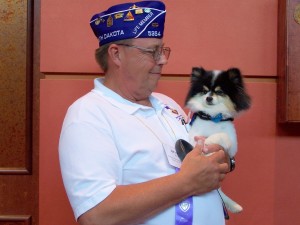 It was a small, black & white, furry 5-pound bundle of emotional and physical relief. His name was Petie, the keeper of an adult warrior, Purple Heart, Vietnam Veteran.
The vet trained him as his first alert. An important task. Petie knew when his master needed to take his medications. He would wakeup Dennis at various times in the middle of the night so that specific pills were administered at the most critical time in order to keep the Post Traumatic Stress under control.
Dennis trained Petie especially for this purpose. They are best friends and constant companions, never apart. This small, furry medic is essential, not just for the vet’s physical well-being, but even more important, his emotional/mental stability.
Petie alerts Dennis when there is danger in the surroundings. He watches intently everything that goes on with his owner and around his owner. If Petie isn’t comfortable his master knows to pay closer attention to his current environment. If Petie doesn’t like you, more than likely Dennis isn’t going to become too friendly either.
They coexist, two different species, one functioning entity.
There are numerous organizations that train service dogs. Dogs that serve the deaf, blind, and epileptic individual. Dogs that act as the arms and legs of those who no longer have capacity to move on their own. Now, some of these groups are training dogs to do something even more challenging, knowing when their owner may go into a PTSD anxiety attack.
The dog must sense when such attacks may occur before they actually manifest themselves. They know even before the person that something is coming on – giving their owner an opportunity to breathe, use relaxation techniques, and take medication if necessary. They provide a sense of security and well-being in a world filled with unpredictability and potential stressors.
One such training organization is NEADS – Dogs for Deaf and Disabled Americans.
They are conducting an in-depth study of nine-ten Iraq vets who has severe PTSD. The study’s focus is to evaluate the most effective canine training methods that serve the sensitive needs of a veteran suffering from combat stress.
This is a very expensive and challenging research project because it must take into account the behaviors of two very different organisms: human and canine.
It will be a critical piece of information given the increasing number of individuals returning from the Iraq and Afghanistan theaters and those that have served in past wars such as Vietnam and the Gulf War.
Aug
12
Wilderness and Healing PTSD
Filed Under Treating PTSD | 3 Comments
 They come at the most unexpected times; the demons, depression, sadness, anxiety… It is the uncertainty of the unwanted feelings, the never knowing for sure when or where they might appear that makes Post-traumatic Stress such a challenge to manage.
Modern civilization, with all of its new technologies, now has more clever and massive means to torture and kill. And our conscious and unconscious psyche knows and understands this fact. So why in the heck would someone with PTSD feel secure and at ease in a large city, a crowded mall, or a traffic-filled highway?
Many times it is these modern places that exacerbate PTSD symptoms. Finding a place of safety to escape and heal may be to retreat to the wilderness. A place where Mother Nature opens her soft arms to surround us with peace, soothe our torn nerves, and comfort us with gurgling mountain streams, meadows splashed with abundant colors, greens so bright that they almost appear painted. Soft breezes and tiny birds sing a lullaby so sweet that we almost weep with gratitude. Compassionate, wilderness spirits seem to enfold our entire bodies and minds with their loving presence.
This summer we have been fortunate to spend a great deal of time in the mountains: camping, fishing, hiking, floating rivers. Each experience reinforced what we have always known – wilderness places heal.
There is a healing that takes place in the wilderness. Where hatred, greed, and meaningless violence cease to exist. When we are surrounded by wilderness our senses open up to drink in the sights, sounds, smells, tastes, and textures that quiet our minds, hearts, and tattered spirits.
Nature allows us to relax, to rejuvenate. It is why we are blessed to visit each special, wild place. We are privileged to experience natural environments and acknowledge the value of these common places becoming our sacred, healing grounds.
Please send us stories of your wilderness, healing places. We would enjoy hearing from you.
Jul
29
Comparing TBI Injuries and PTSD
Filed Under TBI & PTSD | Comments Off on Comparing TBI Injuries and PTSD
 Last blog we focused on Traumatic Brain Injuries and how similar they can be to the symptoms of Post-traumatic Brain Disorders. To help demonstrate these similarities I have created a chart of Similarities and Differences.
Much of the information is taken from our book, “Tears of a Warrior: A Family’s Story of Combat and Living with PTSD” and soon to be released new book by Laura Whittemore and Mary Ann Keatley, PhD, CCC, “Recovering from Mild Traumatic Brain Injury (MTBI): A Handbook of Hope for Our Military Warriors and Their Families”.
The Whittemore/Keatley book will give some helpful information on MTBIs including numerous questionnaires to assist individuals in recognizing if they need to seek medical services.
Note: Differences will be highlighted in Yellow (MTBIs) and Green (PTSD)
|
Mild Traumatic Brain Injury (MTBI) |
Post-traumatic Stress Disorder (PTSD)
|
|
Physical Symptoms · Headaches · Loss of balance · Vision problems · Dizziness · Loss of sex drive · Loss of energy · Easily fatigued · Sensitivity to light, sound, touch · Sleep disturbances |
Physical Symptoms · Headaches · Loss of sex drive · Loss of energy · Easily fatigued · Sleep disturbances · High blood pressure · Difficulty with digestion · Lower immune systems · High or lower levels of cortisol |
|
Emotional Symptoms · Depression · Mood swings, outbursts · Fearfulness · Apathy · Low motivation · Gullibility · Feeling easily overloaded · Anxiety, frustration · Difficulty managing emotions · Hyper vigilance, exaggerated startle response · Sense of helplessness · Loss of sense of self, low self-esteem · Nightmares · Anger |
Emotional Symptoms · Depression · Mood swings, outbursts · Fearfulness · Apathy · Low motivation · Feeling easily overloaded · Anxiety, frustration · Difficulty managing emotions · Hyper vigilance, exaggerated startle response · Sense of helplessness · Loss of sense of self, low self-esteem · Nightmares · Anger · Panic Attacks |
|
Cognitive Symptoms · Memory loss · Short attention span · Slowed thinking · Disorientation · Brain fatigue · Forgetfulness · Difficulty driving due to brain injury · Word finding and spelling difficulties · Impaired comprehension · Inability to organize thoughts · Inability to multitask · Inability to inhibit certain behaviors (i.e., excessive shopping, gambling…) · Difficulty with abstract thinking |
Cognitive Symptoms · Memory loss · Short attention span · Slowed thinking · Disorientation · Brain fatigue · Forgetfulness · Difficulty driving due to combat trauma… · Word finding and spelling difficulties · Impaired comprehension · Inability to organize thoughts · Inability to multitask · Inability to inhibit certain behaviors (i.e., excessive drinking, use of drugs both prescribed & illegal) · Difficulty with abstract thinking |
As you can readily see when you review the chart, the similarities are numerous which is why getting the most accurate diagnosis is critical. Treatment will differ by therapy options as well as prescribed medications. Improper identification can result in serious setbacks which may compound the individual’s ability to heal and recover from his/her injuries.
May
29
Where are you?
Filed Under American Patriotism | Comments Off on Where are you?
 It was early in the evening, a time when most of us were looking forward to some rest and dinner with our families. A time when we finally had a few minutes for conversation and catching up on each other’s day. In an American town, the police were responding to a domestic disturbance where they arrested a young man who was later charged with drug possession. The drug was an anti-anxiety medicine. Unfortunately, the prescription was not in this person’s name. Opps! This became a Class C felony for a young veteran whose picture of his Iraq experience appeared on Time magazine only weeks before.
For him, like many vets, the combat zone was never far from his mind and heart. Upon returning home, problems continued to plaque the young man. He had difficulty keeping a job, couldn’t seem to stay away from drugs and alcohol, ended up in jail on more than one occasion, and become divorced within two years. Living became too torturous to bear until finally his mother received the news that no mother ever wants to receive.
She had to bury her son too young, too soon.
Stories like this are more numerous than many Americans recognize or acknowledge. An article from the McCormick Foundation stated, “Statistics indicate that approximately 300,000 veterans who have returned from Iraq and Afghanistan suffer from post-traumatic stress disorder (PTSD) or major depression, and about 320,000 may have experienced traumatic brain injury (TBI) during deployment (Lisa H. Jaycox and Terri Tanielian, Invisible Wounds of War, Rand Corporation, 2008).” The battle for peace of mind becomes even more challenging for many military individuals upon returning from war. Most never talk about their experience. Most rarely let others see how complicated it is to live a “normal” existence. Most never complain.
So think about when a warrior dies alone on a battle field far from home, where are you? When he/she returns home and can’t sleep at night because of the flashbacks and nightmares, where are you? When a mother weeps for a son or daughter she will never again hold in her arms, where are you? When a vet is living homeless on your city’s streets because he can’t seem to hold a job or clear his head of the dreadful memories, where are you?
For most, you are at work, at home, on vacation, living your life in a fairly peace-filled manner, even given our current economic upheaval, you are free. You are safe. And you are whole in mind, body, and spirit. Our veterans gave all of that up for you, for me, for others around the world. Be sure to thank a vet. Be sure to say a prayer for their healing. Oh, and extend a Thank You to the family, because everyday they are giving up their own sense of peace and well-being.
May
8
 A few weeks ago, during a book publication meeting, I met a lovely lady, Lois Hjelmstad, who had written a book, Fine Black Lines, of reflections of how she survived cancer told in journal entries, reflections, poetry, and photographs. One of her poems reflected what many veterans and their families have experienced when living with PTSD. Since many of life’s challenges have “emotional” similarities, I thought our blog readers might find this particular selection meaningful.
It’s best to act normal…
To say, “I’m just fine.”
What everyone wants is
A positive sign.
Just smile and say thank you
When people will ask.
One mustn’t let on that
Each day is a task.
Friends keep on calling…
You know they mean well.
But really they’d rather
For you not to tell
Each symptom, each detail,
Each wearisome day.
Or mention that small fear
You can’t drive away.
An illness gets tiring…
For them and for you.
The difference is simple…
They get to quit.
( © 2003 Lois Hjelmstad)
303.781.8974
Wouldn’t it be great if, when the demons appear, one could simply say, “I Quit”, and everything would be normal? The reality of the situation is that warriors Never Quit, they keep on going no matter what battles they are waging. For that, my friends, is the very essence of a true warrior.