BOOK PURCHASE: Discount (above) or PayPal (below)
Click "Buy Now" to continue to PayPal
Click to order eBook - Kindle

Click to order eBook - Nook

Apr
26
Reflecting on a Comment
Filed Under Treating PTSD | 1 Comment
 Before I begin this blog I want to sincerely thank all of you who are following our book and providing feedback. I am well aware of the time it takes to stay aligned with a variety of online communication. It is humbling to know that individuals and families are finding our website helpful, and we are truly grateful for your comments.
Michelle Rosenthal, a reader of our April 15th blog, commented that she liked the last line:
“If we send them, then we must mend them.”
This has been our motto and theme throughout the book and certainly needs to be fully endorsed by our military, our country, our leaders, and our communities. What was thoughtful about Michelle’s comment was her last line where she asked, “How do we mend them in a way that does not inappropriately bend them?” And that, Michelle, is a billion dollar question – one for which I do not have a tangible response. Yet, I can say this, the solution lies in making a difference – one individual at a time. Healing does not fit every military experience or veteran the same. There are far too many variables. However, a few constants will be required: relentless determination to getting better, standing up and trying again even when staying down seems much easier, support from a variety of people (family, friends, the VA…), and most of all a deep feeling of being loved and worthy of love, when at times we feel quite alone.
For those of us living with someone suffering from PTSD, love does not mean accepting or condoning inappropriate behavior from either person. It means putting proper boundaries on our actions, without battering each other. It means that we love and trust each other enough to know that we can get better and want to get better. It means we believe the relationship is worth the effort, the pain, and frustration as long as there is progress toward emotional healing. And in the end, the mending will more than likely require a bit of bending. Perhaps it is only through the “bending” that genuine healing can take place. The key word in Michelle’s comment was “appropriate” bending. In a heavy wind a tree bends – that is a good thing. I’m simply trusting that the tree will sustain the storm because its roots are deep and firmly grounded in an earth that holds tightly to its foundation. Hopefully, if our spiritual and emotional roots are deep and far reaching, perhaps we can and will sustain the storm within. Nothing is impossible.
Apr
15
What Others Say About PTSD
Filed Under PTSD treatment | 3 Comments
 In the last few months I have written about characteristics and effects of PTSD. Some of the information came from years of living with someone with PTSD. Some of it came from over a decade of research. And, some of the information was the result of interviews carried out over the last eight years with families, vets, and civilian populations. A recent blog focused on “What I know for Sure” about this illusive, emotional oppressor and I ended with a comment from a newspaper article where an Iraq veteran stated that admitting he had served in Iraq or Afghanistan was like the plague because employers were apprehensive about hiring vets with PTSD. Reading this put me into a very philosophical guilt trip. We are trying to educate communities, veterans, families and friends about Post-Traumatic Stress Disorder. However, by no means is the information meant to make the vet look incompetent or out of control. PTSD is like any other challenge. Most of the conflict occurs within the person, and behind closed doors. For the most part, few people outside the immediate family have little if any idea of the torment and struggle going on within the individual.
While driving to Wyoming last week, I read an article in Scientific American by David Dobbs (April 2009) titled, “The Post-Traumatic Stress Trap”. The main idea of this piece centered on “a growing number of experts insist that the concept of post-traumatic stress disorder is itself disordered and that soldiers are suffering as a result” (p. 64). As I read the piece I both agreed and disagreed with what Mr. Dobbs wrote. There is no doubt that many people showing symptoms of any type of illness or disorder may be misdiagnosed, and when this occurs treatments are not only ineffective, but may even be harmful to the patient. PTSD is no exception. Just diagnosing, it can be tricky because its symptoms can mask other ailments such as depression, memory problems, and traumatic brain injuries. A helpful statement by Mr. Dobbs reminded the reader that for many vets returning from combat, normal readjustment may take months and even a few years to get back to regular existence. “Seeing most post-combat distress not as a disorder but as part of normal, if not painful, healing” (p. 68), may take some of the stigma away from the trauma of combat.
All of that is fine. Yet, as a researcher, I also know that for those who are misdiagnosed, many may never be identified due to lack of nearby medical facilities or lack of awareness. The last point Mr. Dobbs made, and I believe it is legitimate, refers to revising the rubric for more accurately diagnosing of PTSD. At any rate, the real challenge continues to be accurate identification of PTSD, effective treatment options, and correct information to increase awareness. PTSD is far more than a mere “adjustment” problem. The sufferer and the family need immediate and appropriate interventions if restorative health is to be obtained. As a nation, we have our work cut out for us, because a nation that forgets it warriors, fails its moral and humanitarian obligations to restore to physical and emotional health those it sends into battle. We must always take action; we must always remember that “If we send them, we must mend them”.
Apr
9
What I Know Now About PTSD
Filed Under Treating PTSD | Comments Off on What I Know Now About PTSD
 I thought some of you following our blog might like to read the few things I have learned in almost forty years of living with someone who has PTSD. The list is brief because I chose to focus on What I Know from years of experience, so here they are:
PTSD is an invisible ghost that appears in one’s emotional life at the most unexpected times.
- It is almost impossible to identify all of the triggers – i.e., things that remind the senses: sight, sound, touch, taste, and smell of the past trauma.
- PTSD is the second war the individual must fight once home and it is sometimes even more challenging to succeed.
- This second war can be as hideous as the first. It is often manifested in common places and homes of the veteran. It affects the entire family – parents, siblings, spouses, children….
- PTSD is like throwing a huge rock in the middle of a quiet pond. The ripples extend far beyond the rock’s impact. In many cases the displacement seems to suck everything in its path into a black hole where normal life disappears entirely.
- Ignoring PTSD symptoms does not make them go away. They continue to fester.
- And most hopeful, PTSD can be managed. It can be effectively controlled, but only if the person affected admits there is a problem. As with most problems, awareness is the first step to healing. Taking steps to get the appropriate help, taking the responsibility for the situation, and doing something to heal is absolutely the best, and sometimes the only viable way to move through the life journey with better emotional and physical health.
- One last comment to employers — A person who has fought in combat and served his/her country honorable will definitely serve your organization/company in equal fashion. He/she will be committed to the work and fellow workers. He will be focused on the task at hand and will be relentless in making sure that the job is done well. She will pay attention to the details as well as the big picture. He will be a dependable asset to your organization. And most of all, she deserves the opportunity to have a normal, prosperous, and stable life after what she gave to our country and to us.
Mike MacDonald of the Black Lions CO C 2/28, ’68-69’responded to this recent blog and I thought it was worth adding:
“Demonstrated Team Player” – I run a small company and there are certain things I automatically know about Vets. They can be as disciplined as they need be, are team players, accept direction, are usually task oriented and conscientious.” Thanks, Mike for your comments.
Mar
10
 Celebration: New Veteran’s Center
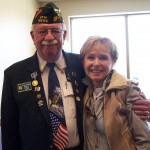
With today’s economic and world issues, it sometimes appears there is little to celebrate. Last Friday morning was an exception. It was the opening of the new VA Clinic in Fort Collins, CO. The Center is a place where our wounded warriors can go to heal, to obtain support for both emotional and physical problems, and a place to get information. Dozens of VA dignitaries, community members, veterans and their families, as well as delegates representing Mark Udall, Michael Bennett, and Betsy Markey attended the special ribbon-cutting celebration. Unquestionably what made the celebration special were the people; people who have given so much in service of our country. And people who are giving so much to heal them: doctors, nurses, therapists, office workers, and the list grows. There were a few individuals I spoke with who moved my heart. The first was Dan Griffin. I didn’t focus on his rank or even the conflict in which he served. These details just didn’t seem all that essential to me at the time. What drew me to Dan Griffin was his solitary stance of dignity. He wore a uniform and hat filled with medals and ribbons. He didn’t mingle much, just stood in a back corner of the room watching, listening. I walked over to him, drawn by his silence and stature. It was obvious he was a shy person – even told me this himself. I asked a few questions of him and he responded to with a minimum of words. Proudly he mentioned to me that next year he will be the Commander of Post 10 of the VFWs – the largest VFW post in the state of Colorado. Then he went on to talk about last summer’s group reunion in Gunnison. He described how much he liked to fish, especially the lakes with the “Big Ones”! Upon leaving, I gave him a hug. What I really wanted to say to Dan Griffin, but the words were caught in my throat, was how much I honored and appreciated his service, his life, his courage.
Then there was Meg Corwin whose quiet sacrifice few people will ever have to endure. She had been a military person for over twenty years, recently retired and now serving on Senator Michael Bennet’s staff. Her husband was shot and killed by a sniper two years ago during his second tour of duty in Iraq. Saying “Thank You” for your service and your husband’s sacrifice just seemed a bit passé. How can one truly thank a person who has given so much? I couldn’t. Ms. Corwin showed such strength and dignity during her speech to the group. I questioned if I could be so brave in similar circumstances – whether I could talk about my loss with such control? Truly, I don’t know the answers. What I do know is this; many families have made similar sacrifices. Many families, mothers, fathers, sisters, brothers, spouses, children, friends mourn their loss silently with wounded hearts and spirits.
The new Veteran’s Center is a place of hope and healing for each of these exceptional individuals. If you know of a veteran or his/her family member, please be thoughtful enough to press their hands and say, “You are special to me. I will try not to forget what you have gone through; what you have given so that America can enjoy her freedom. Thank you.” Keep them in your thoughts and prayers. Do everything you can to live this motto:
If we send them, then we must mend them.
Feb
20
PTSD and female soldiers
Filed Under Treating PTSD | Comments Off on PTSD and female soldiers
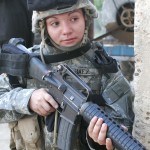
Psych Central has an article about the rising incidents of PTSD in female soldiers. Even though women are technically barred from combat, many are exposed to battle as they serve in support functions in combat areas.
Click here to read the article.
Jan
30
Healing Ain’t Easy
Filed Under Treating PTSD | Comments Off on Healing Ain’t Easy
Va Hospital - Cheyenne, WY
Hello everyone. We have been back from our trip to Vietnam/Cambodia for ten days now. Getting our sleep patterns to normalize has been more challenging than getting our daily routines into a new rhythm. Before we left, I mentioned that we learned a few breathing strategies to use just in case Tony was triggered by a sight, sound, smell… from combat. Tony admitted that the breathing was useful on a few occasions, but he never felt that any of the experiences were overwhelming – another milestone in the lifetime journey of healing. Yea! Yesterday, we went to Cheyenne for a second session of EMDR (Eye Movement Desensitization and Reprocessing) with a veteran’s service therapist. EMDR has been used since the 1980’s with individuals who have experienced a wide range of traumatic events ranging from car accidents, rape, domestic violence… and combat PTSD. The purpose of EMDR is to help the individual reprocess the event in a manner that is not as emotionally volatile, thereby, reconciling the experience into something that is more acceptable to the sufferer. Truthfully, we do not know if this particular type of therapy will work with Tony’s PTSD, but it is worth a try. We know of many non-vets who have told us stories of how EMDR helped them. Since I am being allowed to be part of these sessions, I have already had a few significant Aha moments. The first is getting the patient to move from a cognitive processing mode (in the head) to a feeling mode (in the body), which can be incredibly difficult. Modern man (and woman) has an enormous need to control his environment. It makes us all feel a bit safer when we believe in this illusion of “control”. To move from analyzing everything we experience through our heads and think about how our body is responding; i.e., anxiousness, faster heartbeats, headaches, stomach cramps… is something not many of us think about on a regular basis. In fact, we often take a pill to make the emotional cramping go away. EMDR’s focus is on the “body feeling”. In neuroscience terms, it is an attempt to get both body and mind in closer alignment which, hopefully, allows a person to live in a healthier state of being. The second Aha for me was this: The full impact of a stressful event isn’t when the traumatic event took place, i.e., the utter horror of combat, the killing, the IED explosion…It begins far before that event. It begins before the person landed in the foreign country, got into the car, or encountered the threat. All of the sensory information that came before the actual event were also encoded into the body/brain. So Tony’s beginning started when he received his orders to go to Vietnam: as he boarded the plane, when he first walked off the plane, and when he was being processed in Vietnam for his combat assignment. Wow, what a revelation this was to both of us. I thought that we were only dealing with the trauma from the really terrible experiences. No wonder this thing we call PTSD is so powerful and full of ghosts. It began sooner and there were more ghosts than we ever imagined. No wonder so many vets aren’t excited about therapy. It is enormously difficult, scary, and unsettling work. Not only does it take huge amounts of courage and persistence, it takes a strong support system to stand beside, listen, and observe the wounded. This part of the healing journey may be more complex than we ever thought. I’ll keep you posted as we take one small step at a time. I’m thinking this may be a good time to stock up on comfort food and lots of dark chocolate.