BOOK PURCHASE: Discount (above) or PayPal (below)
Click "Buy Now" to continue to PayPal
Click to order eBook - Kindle

Click to order eBook - Nook

Jan
19
The Nightmare Revisited
Filed Under Life, Peace, Today's War, Trauma, War | Comments Off on The Nightmare Revisited

By Janet J. Seahorn
Last year at this time, Tony and I were in Vietnam and Cambodia. It was a humbling, yet inspiring excursion. As Tony stated many times, he did not go there to heal or recreate the war. He wanted to visit, only to see how things had changed, with hopes that the people and the country were mending.
By all outward appearances hope seemed to be occurring. Yet, what keep coming back to me, were the faces of the old women. We did not see the same number of older men, perhaps because many of this age were killed in the war. The women’s faces were not happy. Their features lined with rivers of anger. It was the eyes that held the emotions, and for many, their emotions were tortuous and hate-filled. What haunts me now are the faces I glimpse in the newspapers of civilians in Iraq and Afghanistan; similar looks living in human bodies experiencing similar horrors of war.
As we continue to read of the escalation of suicides of returning military men and women, I wonder if such unforgettable faces are haunting them. Faces of the enemy, faces of their comrades, faces of the children? In the first few blogs of this New Year, I wrote of Peace. Can it be attained in a person’s mind and heart after experiencing so much? I very much want to believe such a peace is possible. For others, the hideous experiences continue to dig deeper ravines into the soul. To heal, even a bit, these gorges must be filled in gradually.
Perhaps not fully, but even building up the crevasses a little keeps one from falling into the yawning depths of depression, anxiety, and hopelessness. As long as one can look up and see the sky, hope is present. It is when one’s existence is swallowed in darkness that even the tiniest light is diminished. Finding ways to keep the sunlight accessible for our returning vets will be the work of everyone: the nation, its people, families, friends, communities, and most importantly, the veteran.
We have troops leaving daily for the war zone, and others returning. A 2008 Rand Corporation study revealed that 300,000 troops who served in Iraq and Afghanistan had Post-Traumatic Stress, while 320,000 reported probable traumatic brain injuries. Both conditions greatly increase the likelihood of attempted suicide. “According to a Congressional Quarterly compilation in late November 2009, 334 active-duty military service men and women have taken their own lives in 2009” (Edward Pages, 2009: The Year of Soldier’s Suicide), and this does not include those military individuals who have been discharged.
Let us all be sure to look into these eyes of freedom and not dismiss the signs of their sacrifice. Peace and healing is everyone’s work; everyone’s answerability. As a nation, it must be our core mission to mend and heal all those that fought in lands where few of us ever think to venture.
I doubt if many of our returning military personnel have rational thoughts of wanting to return to the combat zone. It took almost forty years for us to do so.
One of our favorite veterans, Michael MacDonald, wrote us the other day relating his response to those who frequently ask him if he ever wants to return to Vietnam for a visit. His reply, “Why, I was just there last night.”
And, for many, this statement is all too true. It is those nights without returning that we pray for in our sleep and dreams. It is those nights without revisiting the nightmares that keep us healing.
Jan
12
Another Perspective on War
Filed Under PTSD, Today's War, Trauma | 1 Comment
by Janet J. Seahorn
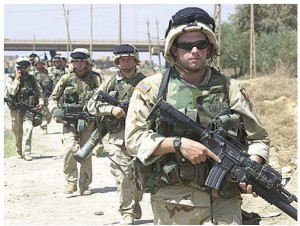
It is a snowy Sunday afternoon. I have been running errands, not because I have a great deal to do after the holidays; to be honest, I am merely trying to keep from thinking about the escalation of the war in Afghanistan. When I got home, Tony had posted a new message on our blog that began with “I seem to spend a lot of time thinking about war, even when I don’t want to. The reality of war. The horror of war…” With this blog he added an article from our local newspaper, The Denver Post. It was another reality check from troops actually involved in war, versus media or political rhetoric.
Every day we get emails, phone calls, or an acquaintance sharing a tragic story about a loved one, friend, or just someone they distantly know who is struggling with Post-Traumatic Stress. For those who have and are serving in the current conflict, the stories are so similar to Vietnam veterans it is down right eerie.
For some individuals the nightmares begin immediately. Others seem OK for the first six months or even a year, and then it begins, the panic attacks, unresolved anger, anxiety, and night terrors. The narratives, however, seem to remain the same. The vet initially attributes the emotions to some external force. He/she claims the feelings aren’t real. Given time, everything will be just fine.
Denial is an interesting strategy and may work for a short time, but sooner or later friends and family members will begin to feel the impact of the warrior’s pain. Owning the trauma is the first step to managing it.
I can’t begin to count how many people who have never served in the military, have never had to sacrifice their physical and emotional lives, have never lived with a parent or sibling who is carrying the war’s trauma in every cell of his body says something like, “there is a silver lining in these wars”, “if we don’t fight them there, we will have to fight them here on American soil”.
It isn’t that these individuals are unkind or uncaring; they merely have not had the experience of combat that comes with a very high personal price tag. The ultimate “Golden Globe of Thoughtlessness”, however, are those who doubt that PTSD even exists, and that if it does, it can be easily treated or overcome with just a little effort and personal fortitude.
OK, I admit, I sound cynical. Perhaps what might appease me a bit is giving all of those “others” a chance to sacrifice a bit of what our veterans are enduring. Perhaps, if the families of those “others” would have to witness and battle the demons in their homes with their loved ones, maybe, just maybe, my irritation would subside a bit. Or, maybe, just maybe, one tour of duty is enough for any warrior.
What I cannot accept is that this current war is being fought by less than one percent of the American population and that one percent isn’t comprised of the well-off and well-to-do. As a country we are passively engaged in a practice that will come to haunt us.
Haunt us as a country; haunt us in our communities; and haunt us as moral beings. For sooner or later, as a nation we will have to face the consequences of our inequitable actions. The price will be expensive and ugly.
I wonder if our country’s leaders and the American people will be willing and able to cover the costs.
Sep
23
The Teeter Totter Journey
Filed Under Life, PTSD | 2 Comments
 by Janet Seahorn
Ever think of life as a “teeter totter journey”? Sometimes you’re up, sometimes your down, and when everything is in perfect balance, you are somewhere in-between.
The biggest challenge on a teeter totter is keeping that perfect balance. The certainty of teeter tottering is that equilibrium doesn’t last very long. As soon as the tiniest shift occurs on either side, the mechanism moves.
When you were a child playing on the teeter totter, the fun wasn’t keeping the slab of wood in balance; it was the fast ups and downs as you tried to give your partner a very exciting ride.
Life is a bit like that teeter totter. Some days we are up, some days down, and, every so often, we are within the perfect balance. If we really examined it, however, we would notice that most of our time is spent in the process of moving between the ups and the downs.
This is not good or bad. It just is. Post-Traumatic Stress can be life’s ultimate teeter totter. The ride is faster, quicker, and more unpredictable than the average, and those times of stability may seem shorter. Those individuals on the PTSD cycle are there for good reason; they have experienced life at some of its highest highs, and it very lowest lows. The speed of change, therefore, tends to be faster, more unpredictable. At times it can make one queasy from experience.
Playing on a teeter totter requires at least two people; you can’t get up without someone on the other end helping you there. It’s a push, pull, and bumps boogie.
Those living with Post-Traumatic Stress and family members who become part of the journey often experience the same unpredictable, sudden change in highs and lows. Yet, perhaps, the most important message in this blog is simply this: if either rider decides to abandon the wooden slab, the remaining rider can be at peril, depending on where they sit.
And herein lies both the gift and the tragedy. Those of us who live with the after effects of combat trauma (or any trauma causation) make a choice every single day to continue the journey together.
Yep, life is a teeter totter journey.
Apr
26
Reflecting on a Comment
Filed Under Treating PTSD | 1 Comment
 Before I begin this blog I want to sincerely thank all of you who are following our book and providing feedback. I am well aware of the time it takes to stay aligned with a variety of online communication. It is humbling to know that individuals and families are finding our website helpful, and we are truly grateful for your comments.
Michelle Rosenthal, a reader of our April 15th blog, commented that she liked the last line:
“If we send them, then we must mend them.”
This has been our motto and theme throughout the book and certainly needs to be fully endorsed by our military, our country, our leaders, and our communities. What was thoughtful about Michelle’s comment was her last line where she asked, “How do we mend them in a way that does not inappropriately bend them?” And that, Michelle, is a billion dollar question – one for which I do not have a tangible response. Yet, I can say this, the solution lies in making a difference – one individual at a time. Healing does not fit every military experience or veteran the same. There are far too many variables. However, a few constants will be required: relentless determination to getting better, standing up and trying again even when staying down seems much easier, support from a variety of people (family, friends, the VA…), and most of all a deep feeling of being loved and worthy of love, when at times we feel quite alone.
For those of us living with someone suffering from PTSD, love does not mean accepting or condoning inappropriate behavior from either person. It means putting proper boundaries on our actions, without battering each other. It means that we love and trust each other enough to know that we can get better and want to get better. It means we believe the relationship is worth the effort, the pain, and frustration as long as there is progress toward emotional healing. And in the end, the mending will more than likely require a bit of bending. Perhaps it is only through the “bending” that genuine healing can take place. The key word in Michelle’s comment was “appropriate” bending. In a heavy wind a tree bends – that is a good thing. I’m simply trusting that the tree will sustain the storm because its roots are deep and firmly grounded in an earth that holds tightly to its foundation. Hopefully, if our spiritual and emotional roots are deep and far reaching, perhaps we can and will sustain the storm within. Nothing is impossible.