BOOK PURCHASE: Discount (above) or PayPal (below)
Click "Buy Now" to continue to PayPal
Click to order eBook - Kindle

Click to order eBook - Nook

Aug
25
SPOUSE NEEDS HELP
Filed Under Black Lions, Combat PTSD, PTSD, PTSD treatment, Tears of a Warrior, War | Comments Off on SPOUSE NEEDS HELP
by Janet J. Seahorn
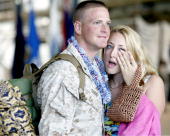
There it is again – another message from a spouse needing help to cope with the conditions his/her companion faces after returning from combat.
Just reading their stories make me feel like weeping, screaming, and wondering… why our various government systems aren’t doing much in this area. To be sure, some Vet centers are implementing some innovative and helpful programs for spouses and families. Yet, far too many are going unnoticed and unheard. Some spouses don’t know where to go to access services; some simply can’t find anything near them that makes it feasible to get such services; and some want/need groups they can access through the internet. As one person explained… I am looking for a group that will tell me what they are going through and how they are handling it. I want some group I can talk to and be open and honest with that I can tell them the things that wives of PTSD vets are afraid to open up about…PLEASE HELP ME TO FIND THAT GROUP I KNOW SOME OF THE THINGS I HAVE GONE THROUGH I DON‘T WANT ANYONE TO KNOW ABOUT…
There is such pain just hanging out in our families and their personal relationships. Pain that few others see. Pain that the spouse and family don’t feel comfortable or safe sharing with anyone other than individuals who have been through similar experiences. Finding appropriate and effective programs need to be a high priority if our veterans and their marriages are to survive in a healthy and positive relationship.
After reading an e-mail from a wife of a Vietnam vet with PTSD who is also the mother of a son who just returned from combat with similar difficulties (double whammy), I responded with this note. I hope she won’t mind me sharing with our readers, since she is only one of hundreds who are worried, discouraged, and questioning what can be done to make things better. In almost every such message, the writer speculates if she has done something wrong or not done enough, whatever enough might be in these situations. Below is my response – I hope it helps.
Please know you have done nothing “wrong by your children”… war has done the damage. PTSD is similar to trying to swim upstream through raging rapids and water falls. It is a moment by moment and daily challenge, but there is hope. The key is to get as much information as possible, set and STICK to appropriate boundaries, and try as hard as you can not to make excuses for your husband’s or son’s behavior. I did this for a very long time and still, at times, fall into this hole. By making excuses for our loved ones, we do not hold them or ourselves accountable for the behavior. Just like any challenging illness or disability, the individual and family must work twice as hard as those not encumbered by the condition. What I was really saying when I made such excuses is that I didn’t believe that either I or my husband could do better or get better, and that simply was not true or accurate. We continue to heal, but we still have our bad days/times, which we know won’t totally disappear. The biggest hope is that we are better than we were before Tony got help with the VA center. By writing the book (Tears of a Warrior), I spent nine years researching the information and thinking about how it related to our situation. I kept saying to myself, “if only I/we had known this when… we could have done so much better or differently”.
It is important that both your husband and son seek help with your nearest VA center. If you aren’t happy with the service there, go somewhere else. We found we had to do that and finally found a wonderful VA center here in Ft. Collins and Cheyenne. ### was not so helpful.
As for your son, I understand how you must feel… both my sons are grown and on their own, but there are times I wish I could “kiss their boo boos, and make the hurt go away” like when they were little. A mother’s heart never is far from those of her children. Just the way it is. Now I tell my sons, “I can not solve their problems, because this is yours to do for yourselves. But I will always be there to listen, support, and love you.” I try to end by telling them this…”I know you are a wonderful, intelligent, and strong person. And I know you have the determination and courage to solve this situation. I know this with all my heart and I trust you. Keep trying. You can do it.”
The other point that I will end with is to ask yourself, “Do we have more good times than bad? Are we both trying and improving?” If the answer is YES, we keep going. If the answer was ever NO, things would be drastically different.
I hope this helps. Please know there is help out there. Check with your VA center to see if their are any support groups for spouses. For some these groups are a big help… I believe one has to be in the right group – not in a group where everyone just complains and leaves more depressed.
One last note: I was truly surprised when I did some recent internet searches on support for spouse to find there are few available. One I found is
http://www.giftfromwithin.org/html/groups.html.
If in all your searching nothing viable is available, think about starting a group. Almost every organization and many services began with one person taking action and building something useful for others who share a similar need.
Best of luck and blessing.
Aug
2
SHELTER DOGS AND PTSD VETS
Filed Under Combat PTSD, Dogs, Life, Love, Pets, PTSD treatment, Service Dogs, Tears of a Warrior, War, Wisdom | Comments Off on SHELTER DOGS AND PTSD VETS
by Janet J. Seahorn

It is such a privilege to write our blogs and then hear back from some of our readers. The blog on “Tears of a Mother” brought many wonderful comments. One such reader sent this message which made me smile. He wrote:
A SHORT STORY. MY WIFE AND I HAVE BEEN MARRIED FOR 40 YEARS. WE ARE HIGH SCHOOL SWEETHEARTS AND WHEN I GOT HOME FROM MY LAST HOSP STAY FOR A PANIC ATTACK, I ASKED HER WHY SHE HAS STAYED WITH ME FOR SO LONG. HER EXACT WORDS WERE. “I KNEW YOU WERE A CHANGED PERSON WHEN YOU GOT HOME. HER FRIENDS AND FAMILY SAID I WAS DAMAGED. SHE TOLD THEM THAT THE MAN IS SCARED OF EVERYTHING AROUND HIM. AND THAT SHE LOVED ME”. I DO NOT TRAVEL TOO FAR WITHOUT MY WIFE. I CALL HER MY HANDLER.
Isn’t that just the sweetest compliment he gave his wife, “my handler”, which, as you can see, he stated with genuine love and gratitude. His message reminded me of a very endearing commercial for “shelter” dogs we have here in Colorado. It starts out, “Don’t pity a shelter dog — honor him. Shelter dogs aren’t broken, they’ve just experienced a little more of life. In many ancient times they would be considered wise. They are the ones with tales to tell and stories to write. They have faced life’s challenges with courage and pride, and survived with honor and dignity”.
Sounds like many of our amazing vets. Just like these shelter dogs who have experienced a bit more than their canine siblings, veterans aren’t broken, damaged, or to be pitied. Most have gathered a deeper wisdom regarding life. And, yes, they have tales to tell and stories to write. With courage and pride they continue to live every day of their lives with honor and dignity.
Shelter dogs and vets. Golly, what a wonderful way to view the challenges of life…and PTSD.
Jun
24
Healing Waters & Wounded Warriors
Filed Under Healing Waters, Tears of a Warrior, Trauma, Treating PTSD, War | 1 Comment
 by Janet J. Seahorn
How do we mend a wounded body or soul? How do we take a step forward in healing a spirit that has been battered by the trauma of battle? One possibility is to introduce the wounded warrior to a place of cooling waters, a place where fish are abundant and one can float through the waters which hum a soothing lullaby of serenity. Project Healing Waters is a volunteer organization that is dedicated to supporting the mending process of military personnel and veterans who have been impacted by the effects of combat. And it uses waters and fly fishing to achieve its mission.
The idea originated when its founder, Ed Nicholson, a veteran of previous war, was himself being treated at Walter Reed Medical Center in Washington D.C. when he noticed a number of young warriors sitting idly in the waiting room. Ed decided to invite several to go fishing with him. On that first excursion, he discovered how this simple fishing experience made a huge difference both physically and emotionally with the young vets. Where eyes were once vacant, there was now a light of excitement; where physical energy was almost stagnate, a resurgence of vigor returned; and where a life seemed consumed by pain and hopelessness, Mother Nature breathed her message of rebirth and Trust into the mind, heart, body, and soul of the wounded warrior.
Ironically, the Healing Waters Foundation has found that the greatest challenge is getting Wounded Warriors to the program. Recruitment is a huge obstacle, partly because of the physical and emotional needs of the individuals, and partly because of the legal ramifications of the vet centers/hospital treating the individuals. Gosh, I never imagined the number of logistical barriers faced by organizations wanting to help make a difference.
Project Healing Waters tries to work through a VA therapist to identify prospective participants. By having a solid system in place, both the support organization and the VA centers can offer a clearer, more holistic approach to healing. The intervention received by the vet can then be measured and assessed as to what works best and why. This knowledge can then be shared with other VA centers and hospitals across the United States.
Ancient cultures have long understood that wounds of the body and soul need a holistic approach for healing to occur. Medications, cognitive therapies, surgeries simply aren’t enough. Where medications have some difficult side effects, nature offers only blessings. Where daily life often brings disorder, there is an order in nature – a way in which all things seem divinely connected from a single rain drop to a flowering mountain meadow. Where days feel misaligned, nature realigns the soul and spirit, letting us knows that all is as it should be. And where our day- by-day activities may seem bounded by the constraints of “to do lists”, nature chants a song of freedom, encouraging us to spread our wings and soar – even if these wings feel shattered.
So, if you are a disabled vet, knock down the door of your local VA center or hospital and request that your medical personnel get you aligned with a volunteer from Healing Waters. This can also be a breathtaking opportunity for you and your family.
Healing Waters volunteers serve as mentors and companions to our country’s wounded warriors. Their mission is uncomplicated – it is merely about healing and mending minds, bodies, and spirits – one unhurried cast at a time – one soothing river somewhere in America. Casting, Healing. Casting, Healing. Casting, Healing, and the wounds begin to slowly mend.
HEALING WATERS
My soul was battered by combat’s horrors,
So I went to the water to heal.
Wounds covered by flesh with war torn scars,
I went to the water to heal.
My heart was broken unable to feel,
I went to the water to heal.
And the water murmured softly–
Be at peace my precious son
Your soul is safe,
Your battles are done.
My waters shall cool and soothe your weary heart,
You came to me
Your healing can now start.
Not knowing where to turn for comfort or for calm,
I went to the water to heal.
The deafening clatter of ghosts from the past,
I went to the water to heal.
The strain of the city made my sanity reel,
I went to the water to heal.
And the water murmured softly
Sit beside me and be still,
Listen to my tranquil song
Let your soul be filled.
My waters shall comfort your torn and tattered soul.
You came to me
I will purge you of your foes.
For sacred, healing waters
are not new to any man,
They’ve been around a long time
Lapping shores of golden sand.
Silently restoring with their tender, gentle hands
A Life to kinder being
Healing water shall command.
by Janet J. Seahorn
Jun
3
Memorial Day in Evanston, WY
Filed Under American Patriotism, Events, Family, Memorial Day, Tears of a Warrior, War | 1 Comment
by Janet J. Seahorn
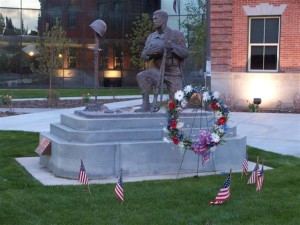
You hear stories about the patriotism of small town USA. The way the community comes together as a single entity to honor its military – those individuals who have served our country. The events always include a bit of flag waving and back patting, “Thank you for your service”. This Memorial Day we had the honor to experience one such town. This is a town, Evanston, Wyoming, which far exceeded any story or past city we have visited.
It was early Sunday evening when we arrived in Evanston. Tony was asked to be the guest speaker at their annual Memorial Day event. We had just returned the day before from Europe. Both of us were more than a bit jet lagged, and I was secretly wishing I was sleeping in my comfy bed back home and wondering what the heck we were thinking when we first accepted the speaking engagement.

As we drove through the streets around town, we noticed flags flying from bridges, street corners, store shops, and of course homes. More flags than we have ever seen. The cemetery was filled with flags and brightly colored flower arrangements. A motorcycle bike rally made the atmosphere even more charged.
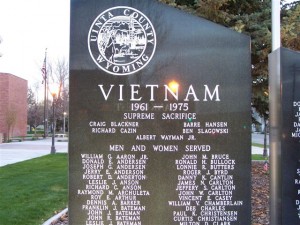
Then we passed a truly humbling sight, the town’s monuments set right in the center of the Court House and Civic Center. Monuments that went way back to the Civil War. The most interesting two tributes were to the Korean and Vietnam conflicts. These were modeled after the Vietnam Wall in Washington D.C. What made them unique, however, was the black granite slabs held the names of every resident of the county who served in the war zone, not just the names of those who had died. The words carved into one stature said it well, “All gave some; some gave all”. Wow! We have never seen a town where every military person was acknowledged. You could trace the heritage of the community’s military generations from WW I forward. Many families had at least four or more last names engraved on each monument. So much sacrifice for a household to bear.
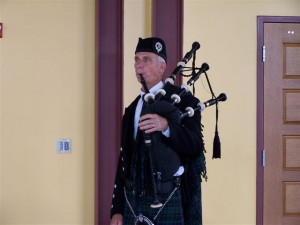
As we listened to the Memorial Day speeches, watched the presentation of flags honoring all military branches, including a flag for the POWs and the MIAs, heard the hallowed sounds of the bagpiper bellowing Amazing Grace, and viewed the solemn and appreciative faces of the people, it was a “lump in the throat” experience. Yes siree, Evanston, Wyoming is truly one of America’s most patriotic towns. It was obvious that such gratitude is a daily way of life, not merely a one day event. They live the words, God Bless America, and God Bless those who serve her mission of freedom and liberty for all.
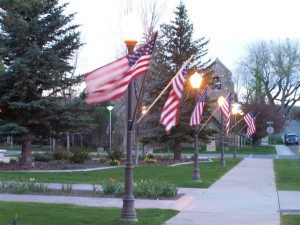
Thank you for sharing your patriotic spirit with us and showing the world that honor, integrity, and flag waving are not political statements, but a way to demonstrate respect for the sacrifice given by the few, so that the many can live in a land of abundance and independence.
May
25
PTSD Series Discussion #3
Filed Under Combat PTSD, PTSD, PTSD treatment, Tears of a Warrior, Treating PTSD, War | Comments Off on PTSD Series Discussion #3
 Question 4: If I, as a serviceperson, have PTSD, how can I help myself?
First, be honest with yourself. As stated in the last question, do not ignore the signs that you are suffering from serving in combat. Do not pretend that things are fine; that the problem lies with everyone around you such as your spouse, children, neighbors, family, or co-workers. Watch for signs such as increased anger, irritability, depression, and/or isolation from normal family events. Resisting the feelings associated with PTSD only exacerbates the problem. The best thing you can do if you think something is not normal is to visit your Veteran’s Center as soon as possible. These centers have become much more proficient in serving the military population’s needs than they were during past conflicts. Physicians and therapists now recognize and understand in better detail the effects of PTSD and how to treat it. Don’t wait. Help is available. The sooner you get assistance, the sooner your life will begin to move forward in a manner that allows you to live more fully. You deserve to be at peace, to be happy and so does your family. You and your loved ones have given enough in serving your country. Now it is time that your country does something for you. Help is waiting; don’t wait another minute to get it. Life is too precious to be wasted fighting demons from the past. Today is the only thing you have that will make a difference for tomorrow. So use today wisely to gain understanding, healing, and perhaps some peace of mind and spirit.
Other suggestions include spending time outdoors. Nature offers us a tremendous healing environment, especially for emotional wounds. We find hiking, fishing, skiing, and simply just being in the wilderness soothes much of our anxieties and internal tensions. Pets are also a therapeutic comfort. A great deal of research has been conducted that has shown the positive impact animals have on a person’s well being. Because our pets love us unconditionally, are non-judgmental, and provide a sense of safety and security, they are one of the very best options for keeping us sane and healthier both physically and emotionally. A few additional suggestions that we have found quite beneficial are meditation, aroma therapy (no kidding J), body massage, and heavy doses of laughter. Humor is a terrific medication since it is almost impossible to be angry and laughing at the same time. It releases endorphins that alleviate body pain, and provides a huge dose of oxygen to the brain and muscles.
Question 5: What can I, as a family member, do to help someone with PTSD or a TBI?
There can be a major difference between a person suffering from PTSD and someone who has incurred a TBI (traumatic brain injury). A TBI is a physical injury to the brain, where PTSD is more a reordering of the neuro networks in the brain. Many times a person with a TBI may also have some form of PTSD, mainly because he/she was in a situation that caused physical and emotional damage to the individual and/or others in the company. As with all illness and trauma, the more informed you become the better you are at making appropriate decisions in handling the circumstances. Illness and problems must first begin with immediate recognition that something is not quite right. The sooner you recognize the signs of PTSD, the sooner you can begin the healing process. Once again, it is dangerous to ignore the obvious and pretend things will get better with time. Too often, this does not happen by itself. Time can make behaviors and tensions more precarious, destroying personal relationships and family cohesion. No one benefits by waiting. Spouses get tired of walking through the “mindfields” of the traumatized serviceperson. Children suffer because they can’t and don’t’ understand why mommy or daddy are not always the same kind; loving parents they were before war.
When a family member returns from combat with PTSD, everyone close to him must join together to offer support, hope, and comfort. In doing so, however, you must set suitable boundaries that will keep the family safe and well-balanced. If children are involved, they must be at the forefront of your concern. Their physical and emotional well-being is of utmost important. Living with a parent who has untreated PTSD can have long-term, negative consequences on a developing child. Getting immediate treatment for your spouse and yourself will be the best line of defense in moving towards the life you want to live and the family unit you want to be.
May
18
PTSD Series Discussion #2
Filed Under Combat PTSD, PTSD, PTSD treatment, Tears of a Warrior, War | 1 Comment
 Question: 2: Is PTSD different from Combat Stress?
The answer to this question may depend on which study you might read or which doctor is doing the diagnosis. Combat Stress has often been referred to as PTSD. “During the Civil War they called it Irritable Heart. During World War I and II it was referred to as Soldier’s Heart or Shell Shock and other terms described it as Neurosis, Combat Fatigue, or Combat Exhaustion (pp. 66-67, Tears of a Warrior, 2010). Every war has coined a term that seemed to describe a warrior who returned from combat with behaviors and reactions that were not a part of his/her life before the battles. Whatever one might prefer to call the behavior is not important. What is important is if the behavior interferes with the person’s ability to live a normal, happy life or the behavior negatively impacts family, friends, or work, you should get help immediately. Today, PTSD is the accepted medical term for similar symptoms from all wars.
Question 3: If my serviceperson has PTSD, will it better?
Our belief is that those suffering from PTSD can and will get better. Some fortunate few whose trauma is not as intense may be able to heal on their own. Most, however, who have seen too much, done too much, lost too much, may only move towards healing with the outside support of a trained physician or therapist. For many, like my husband, there has been no such thing as a full cure. Nevertheless, appropriate medication, counseling, and self-meditation have been a tremendous help in getting to that “better” place. With “better” understanding of what the person is facing and how those closest to him/her can offer appropriate support, the family can become a safer, stronger and more caring unit. Pretending that nothing is happening or that in some miraculous way tomorrow you will awake and all the bad stuff will be gone, is simply not realistic. It doesn’t just go away, no matter how hard you try. In fact, trying harder often makes the situation worse. The best approach to addressing these ongoing painful ghosts is information, productive action, and the courage to admit something is not quite right. Obtaining the help and treatment needed to move towards better physical and emotional health is the best step to recovery.
Mar
24
SNOTTY FISH AND PTSD
Filed Under Life, Love, PTSD, Trauma, War | Comments Off on SNOTTY FISH AND PTSD
by Janet J. Seahorn
 This weekend I heard an experienced angler talk about the joys of being in a stream or lake fishing for Snotty Fish. Snotty Fish, he thoughtfully explained, were those fish that were not easy to catch. They were fish that could not be tricked by some ordinary fly or enticing lure. More than likely, such fish had, in some earlier time, been caught before and managed to escape through sheer luck, tenacity, or down right determination. After going through such a traumatic encounter, they were more cautious than most of their finned friends. They understood the consequences of impulsively taking the enticing lure. Therefore, the fisherman who caught (and released) such a Snotty Fish had to be incredibly patient, knowledgeable, and persistent. This particular angler made it clear that catching Snotty Fish was the best and most rewarding way to angle.
Listening to this person talk, I began to comparing how similar Snotty Fish were to veterans who are living with Post-Traumatic Stress. Many of our troops have experienced the traumas of combat. Men and women who have seen and participated in some of humanities worst deeds; deeds that stay etched on the mind and heart. Vets, who when they return to the mainstreams of society, may be unable to trust others, their governments, and even themselves. Yep, Snotty Vets!
Snotty Vets, like Snotty Fish, are often hard to play out. They have experienced lessons in life that few of their fellow countrymen have ever imagined. Such knowledge often makes them wary of their surroundings, including trusting in their own abilities and worthiness. For family and friends, this knowledge can make these Snotty Vets difficult to live with and understand.
Yet, here is the beauty of being in streams with Snotty Vets—they are worth the time and effort to catch and reel back to wellbeing. Health care professionals recognize this fact. Families, friends and communities who walk the path through appropriate support, timely information and love come to empathize with the journey and value the internal strength, courage, and effort that each of them must live out in order to heal.
So you see, Snotty Vets like Snotty Fish are well worth such effort. Simply swimming in their waters help us have greater gratitude for their sacrifice.
Here’s a toast to all of you Snotty Vets, and to all the spouses, children, and siblings of Snotty Vets: “May your new streams be filled with an abundance of peace, joy, and good vigor. May your days bring you fulfillment, and your nights quiet rest. And may you continue to embrace your Snotty strength and leave behind the sorrows of the battlefield. For you are our precious Snotty Vets. We love you. We honor you. And, most of all, we need you to become whole again.”
Mar
22
What’s Worth Fighting For
Filed Under American Patriotism, Life, War | Comments Off on What’s Worth Fighting For
by Janet J. Seahorn
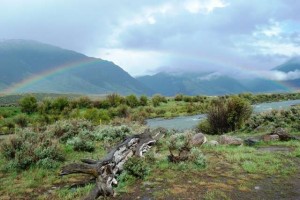 Some people may have a difficult time understanding what in this world would be worth giving one’s life. The courage to go into battle knowing the possibilities. Watching while others die or are severely wounded, and still continue to fight. Many poets and philosophers have written how significant it is to live life for something beyond oneself. To live for a cause greater than yourself. This short video was sent to me by my brother. While I listened to the music and watched the screen, it was abundantly obvious why America is definitely worth fighting for. Beyond any political agenda, beyond any religious belief, beyond the love of family and friends, America has given us bountiful blessings with such amazing beauty. Yes, America is not only beautiful; it is worth living and dying for in our lifetime.
http://sagebrushpatriot.com/america.htm
Mar
2
Honoring Warriors
Filed Under American Patriotism, Events, PTSD, Quilts of Valor | 1 Comment
Veterans
by Janet Seahorn
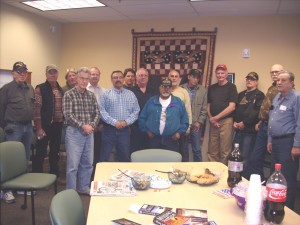
At first it appeared to be an ordinary Thursday evening in mid-February. The soldiers of battles-past gathered at the new Fort Collins Vet Center for their weekly group meeting with the professional VA Staff.
They draw together to heal wounds that occurred long ago in a land far from home. Wounds acquired from serving in Vietnam – a war where few were honored for their personal sacrifice for their country. The veterans meet to try and understand why their scars linger and are still so painful after so many years. And they meet to try and find a sense of recognition of what each has experienced in life – both past and present.
It was on this night that several Fort Collins community members presented a “Quilt of Valor” to those warriors who gave much and were given little in return. Through their generous donations, the community was able to acquire a special hand-made quilt for the presentation.
The quilt was one small way of saying “Thank you for your service and sacrifice”. And, maybe, the quilt would become a symbol of comfort, hope, and honor. This particular comforter was carefully crafted by Donna Roche and the Quilters of Rogers, Arkansas. Her group has assembled and mailed over 700 similar quilts to wounded warriors in hospitals in Iraq, Afghanistan, Germany and the United States. Ms. Roche and her group explain the Quilt of Valor in this manner:
“The Quilt of Valor is our wounded warrior award for service, sacrifice and valor in the line of duty. It is our way of saying “Thank you for your service – you have not been forgotten.” Many caring souls are involved in making the quilts; from contributing quilt blocks, finishing the tops, and integrating each section into the final product. Each special quilt receives a “Quilt of Valor” label thanking the injured warrior for his/her dedication and sacrifice. The label contains the name of those involved in the making of each caring blanket.”
The Quilt of Valor is in fact a symbol of renewal. It transforms the hands of war’s destruction through the caring quilter’s fingers of each blanket’s construction. It shifts the heart from the darkness of combat to the light of a kinder future. And, hopefully it moves the experiences of combat trauma to a quieter sense of peace.
On this Thursday evening, warriors who were never honored finally have their Quilt of Valor. The gratitude in their teary eyes, said it all. Perhaps, after all these years, others do care. Perhaps, there is now a sense of acknowledgement of what these warriors gave without hesitation. You see, it is never too late to say thank you, and the heart is never too old to feel the warmth of such a genuine gesture.
Jan
12
Another Perspective on War
Filed Under PTSD, Today's War, Trauma | 1 Comment