BOOK PURCHASE: Discount (above) or PayPal (below)
Click "Buy Now" to continue to PayPal
Click to order eBook - Kindle

Click to order eBook - Nook

Jun
17
LIVING STORIES
Filed Under Combat PTSD, Life, PTSD, Tears of a Warrior, Trauma, Treating PTSD, Veterans, War | Comments Off on LIVING STORIES
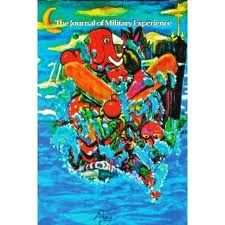
It came in the mail, a book from a professor at Eastern Kentucky University, The Journal of Military Experience. Most publications I get from universities are on topics that deal with academia, you know – ways to teach literacy, how the brain works, and other research topics. This book was different. It wasn’t written by a bunch of stuffy professors based on their special investigative studies. Nope, this book was written by a group of young veterans who had served overseas and were trying to reintegrate into civilian and academic life. Needless to say, many of the stories and poems were composed with emotions that were still raw from combat.
The authors were students in Professor Travis Martin’s writing class. The purpose of his unique course was to help with the initial assimilation phase of university life. “Some of the authors write about the unspeakable things that they have been asked to do, or more accurately, that have been done to them. But some focus solely on that work of translation, making sense of a warrior culture and the mentality of an individual who has been bred, trained, and conditioned by a society in desperate need of a few willing to sacrifice for the many (Introduction).”
The theme in many pieces confirmed how challenging returning from war was for these young warriors. They wrote about who they were before combat and how they had changed from the experience. How seeing friends die before their eyes, how being shot at on a regular basis, how tough it was to determine who would live or perish depending on their interpretation of an approaching car or a family on the side of the road, how these battle experiences made their time during and after conflict more demanding. One marine described “every day someone else would die or get seriously injured. One of my friends lost his legs from a roadside bomb right outside our front gate at 0200 in the morning (Guy Robert Lubin, p. 6-7)”.
Yet, in spite of all of the horror, all the wounds both physical and emotional, not one individual regretted serving his country. Not one person wished he/she did not complete a tour of duty overseas. What some did question, though, was when or if they would ever be free from the fiends of warfare. One author acknowledged “you truly stop caring. You don’t want to shoot, but you will. You won’t think about it, until you get home that is (Bradley Johnson, p. 53)”. He continued, “While you fight and suffer and struggle, you are also changing, becoming someone totally different. The harsh and violent realities of war forces you to change. Emotions are an inconvenience — they distract you — making you feel and think instead of react. A distracted soldier is a dead soldier. My evolution was a great thing on the battlefield, but it is just as much a bad thing when you get home (p. 53)”.
In this book, there are profound words and stories from those few who have given so much for freedom in our country and lands far away. They are “living stories” from real warriors. They ask nothing but a smidgen of understanding and a bit of healing when they return. For every vet past, present or future let us value the sacrifice and honor the service never failing to remember how all gave some, while some gave all.
Jun
13
WHAT YOU DON’T TALK ABOUT
Filed Under Combat PTSD, PTSD, Tears of a Warrior, Trauma, Treating PTSD, Veterans, War | Comments Off on WHAT YOU DON’T TALK ABOUT
by Janet J. Seahorn, Ph.D
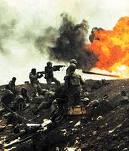
It was something I was not going to do – view the HBO special War Torn.
I tried watching it almost two months ago but didn’t last ten minutes before I had to turn off the DVD. It had too many reminders of suffering associated with the aftermath of combat. Yet, last night I decided to see what it had to say about PTSD, since this has been our mission for the last twelve years – including research & writing.
Throughout the movie there seemed to be a very powerful, recurring theme, a theme of silence. Silence made the veteran a prisoner of his/her own memories. It did not matter what branch of the military a person served – Army, Navy, Marines, Air Force, National Guard…
The role one played during combat was quite expansive, overwhelming individuals who served in all facets of war. From the front lines of combat, to medics, nurses, body baggers, and any person who had participated in the tensions of war. What was similar, however, was the manner in which the experiences were seared on the mind, body, and spirit. This mark of trauma often left the individual with a sense of hopelessness, apprehension, torment, and sometimes shame.
Then, to add insult to injury, when the vet came home… home to a place that he/she would feel safe and normal, returning to civilian life sometimes added greater stress. Many family members and friends simply wanted the vet to be like he was before he left for war. Become normal again.
Perhaps these words might offer some understanding of what isn’t talked about and isn’t said when a war veteran returns home.
THINGS YOU DON‘T TALK ABOUT
By Janet J. Seahorn, Ph.D.
What don’t you talk about,
You survivors of war?
You, who are suppose to be brave,
To be fearless and bold.
You, who have witnessed the best of mankind,
And the worst.
You, who daily endured death;
Who lived with the unknown
The woundedness of others
And the scars within yourself.
What don’t you talk about,
You warriors of battles recent and old?
The panic attacks that grip your throat,
The night sweats from vivid dreams;
Anxieties that propel you to a universe
That seems out of control.
Anger unprovoked and dangerously destructive.
The self-medication… attempts to silence
The voices and erase the gory scenes.
What don’t you talk about
You, who cry with Silent Screams?
You, who cannot seem to find your words,
For words are too simple, too clean
To describe your distress
To others who have no concept of war.
For what you don’t talk about
Your brother and sister warriors understand.
They have been to that place of darkness.
They know – and in that knowing
They are there to walk beside you
If only in spirit.
Perhaps these fellow casualties
Make talk a bit less necessary.
Jun
6
I AM
Filed Under Civilian life, Combat PTSD, Life, Love, Peace, PTSD, Tears of a Warrior, Treating PTSD, Veterans | Comments Off on I AM
by Janet J. Seahorn, Ph.D
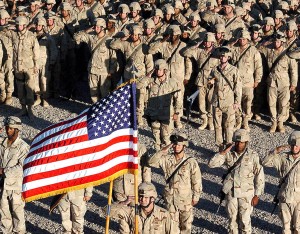
For many of our military men and women who return from combat there is a burning question; a question that asks, “Who am I?” Who am I now that I have seen so much, done so much, and heard the despair of so many? For some there may be a feeling of unworthiness, a gnawing numbness of pain. They seek answers that seem to elude them; answers hidden somewhere between the battle fields and the present.
Every person wants to be validated in the world: to be seen, to be heard, to be felt. Returning from war often leaves a person with a sense of invisibility. A feeling that adds to the question, Who am I … this other person who wanders a world that once was so familiar now feels like a drifter in a land that may not seem recognizable.
Know this one simple truth, You are worthy of love. You are worthy of goodness. You are worthy of a life of joy and personal fulfillment. The trick is not that others view you as worthy. You must believe this for yourself. “You are responsible for your life”. And only You can create and live such a life. You alone must believe that you are worthy to live a good life and a life of meaning.
Combat can take one’s sense of self, but it does not take away one’s need to be a part of something, some mission, some worthy cause. The heartbreaking reality for many veterans is returning from battle with a frame of mind of being untrained to live in civilian society. You will need to work hard to find your path in this world after combat. No one can do this for you. It is a journey each individual will need to travel and seek out.
Some doubt they are up to the challenge. This is purely self deception. If you could be trained to perform all of the incredible feats of a skilled warrior, you certainly have the strength, intelligence and willpower to succeed in becoming your very best “I AM”. The gift has always been yours. It was bestowed on you at birth. The outside world may work hard to convince you otherwise. Some days it may be tempting to give up the search. But carry on. In your hands lies the power to choose.
Choose to accept your very best I AM.
May
28
THANK YOU FOR SERVING
Filed Under American Patriotism, Dogs, Events, Memorial Day, PTSD, PTSD treatment, Tears of a Warrior, Veterans, War, Wisdom | Comments Off on THANK YOU FOR SERVING
by Janet J. Seahorn, Ph.D
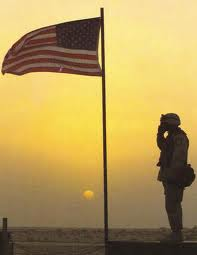
Such a simple phrase stated on too few occasions by too few individuals.
During our travels we get opportunities to visit some special places that offer discounts or free admission to veterans. Most of the time people are pretty gracious. Then there are those situations where the “keeper of the gate” are, in my opinion, just plain ignorant on how to treat veterans.
We have heard stories over and over again on this topic. Some are quite sad, while others are pretty darn funny. On one recent occasion we were visiting a National Park. Tony was asked to show the gatekeeper his driver’s license along with other proof of identity. He had already given her his National Park’s Access Pass for Disabled Vets along with his VA Identification card with picture and signature. Animals with embedded ID’s aren’t scrutinized as rigidly. After all the ID confirmations, she could clearly see he had more than provided adequate identification, yet she still insisted on seeing his driver’s license and two other forms of identification with his signature on it.

This scenario that was absurdly comical. Yet, another part was perfectly annoying. After we jumped through the “gate keeper’s” hoops, we moved forward. Only later after driving several miles down the road did I think of the perfect reply. The next time (and there will be a next time) we’re asked to wiggle through silly bureaucratic hoops, when they are finished with their requests, I am going to respond kindly with the following:

You really meant to say: “Welcome Home and Thank You for Your Service.”
I must admit it will be a bit amusing to see the reaction.
Memorial Day is a time to give recognition and say a prayer of gratitude for all who have paid the supreme sacrifice for serving their country. We should never forget.
 All our military personnel and veterans are our quiet role models and noble heroes.
These deserve our respect.
FREEDOM IS NOT FREE.
May
19
TOUCHED BY COURAGE
Filed Under Brain Injury, Combat PTSD, Events, Family, Giving, Life, Love, PTSD, TBI & PTSD, Tears of a Warrior, Trauma, Veterans, Wisdom | Comments Off on TOUCHED BY COURAGE
by Janet J. Seahorn, Ph.D

A few weeks ago, Tony and I spent several days in the Grand Strand area of Myrtle Beach, South Carolina.
It was Military Appreciation Week.
Due to the special invitation of Retired Army Officer Sinclair Swan, we had the privilege of working with two local groups of military veterans, their spouses and family members.
During the day we met with several group members and their spouses. It was an amazing opportunity to not just speak to the individuals in attendance, but to listen and hear their stories as well. Each account reminded us of the enormous amount of courage it takes to get up each day, live it as best one can, and give back to others.
Two of the veterans have adult children who experienced traumatic car accidents which left them with severe head injuries. These vets are now the primary care givers. Not only have they endured their own trauma; now they must bear the suffering of their children. Several are challenged by serious health issues for them and/or their spouses.
Yet, they continue with great effort and fortitude to move forward. It is a humbling gift to have others shares their trauma and heartbreaks.
Contrary to some public perspective, most of these vets have lived and are living successful and productive lives. In spite of their demons, they have deliberately chosen to not let the past destroy the future. They have elected to make a difference for themselves, their families, their communities. Sinclair Swan meets every Saturday with vets who need help in filling out government forms to obtain services. Each has made significant contributions to serving others.
One individual wrote a special poem many years ago. Upon returning from Vietnam he described how he became homeless, sleeping in parks, and getting his “fixes” when needed. Then, one day, another homeless friend suggested they go to a church soup kitchen for a meal. It was there that a miracle occurred and his life changed. He got his faith back, his spirit, and eventually his life. At that time he wrote a poem which he has allowed us to share with you.
A Poem
By William Huffaker
If I only had one wish to make,
but that wish would surely come true.
I’d wish that I would be given the light
to turn the darkest sky into blue.
Now to you this may sound
like my mythical dreams
have blurred my vision
so that this only seems
to be an illusion
of hopeful abound,
and that my wish
I’ve not really found.
But I’ve found it I tell you.
As I’ve sought it in truth.
And I know now this answers’
been here since my youth.
But I just couldn’t see
through the clouds in my mind.
Through delusions of grandeur
I just couldn’t find.
This fabulous dream
that just had to be,
waiting and knowing,
someday that I’d see.
And even though skies
still sometimes turn black.
And visions of grandeur
still sometimes come back.
I know that there’s light
in the darkest of night.
And the tenderest loves
never far from my sight.
And now that my dream
has become something true.
If I had one more wish,
I would wish it for you.
Apr
19
THE POWER OF ONE
Filed Under Combat PTSD, Tears of a Warrior, War | Comments Off on THE POWER OF ONE
by Janet J. Seahorn, Ph.D
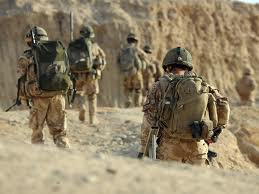
The title is not totally mine. It was taken from the book which tells the story about the life of a young boy’s quest to become a champion boxer. The journey is one of trauma, discrimination, and blessings. Its moral defines the force of relentless belief in a goal; a goal that impacts not merely the individual, but the larger world. Such ambition would require determination, persistence, courage, goodness, and an immense sense of faith even when walking through absolute darkness.
The Power of One refers to the mind which is the real athlete who primes the body to perform. It is the mind which keeps the individual stable as life becomes fragile. Like walking a tight rope over a raging river gorge, the mind works to convince the body that it is safe even when every nerve cell signals, “You must be kidding”. If you think about what is below the wire your focus will be on falling not on moving forward. So many disturbances fight to invade your concentration, and this is a most dangerous part of trauma… when you lose sight of what you want in your life and accept what you don’t want.
Trauma has its own unique composition. That structure, like any challenging illness, can be incredibly complex. It takes the whole of the person to succeed when all you want to do is give in and give up. The numerous types of events that can cause trauma, the support one receives after the event(s), the person’s internal strength and optimism, all contribute to the trauma’s set of symptoms. No two people’s puzzles are identical, because no two lives are exactly the same.
For every vet and his/her extended family, healing and moving forward will certainly take the Power of One, and that One is YOU! Trust in you own untried capacity (Ella Wilcox). Every day believe YOU are strong enough to make this journey, humble enough to seek help when needed, and gritty enough to succeed.
Mar
31
STEALING SPIRITS
Filed Under Combat PTSD, Human Rights, PTSD, Tears of a Warrior, Wisdom | Comments Off on STEALING SPIRITS
by Janet J. Seahorn, Ph.D

Last week we did a ten day road trip through Colorado, New Mexico, Arizona, and Utah. One place we visited was Monument Valley, a beautiful, hauntingly desolate landscape of red sandstone formations rising up from the thirsty valley floor. This region is a sacred Indian worship site belonging to the Dine tribe. Many sacred locations remain private for ceremonies held by Navajo tribes along the Arizona & Utah border.
Although the valley has been open to the public for decades, I still felt reluctant to enter its sacred domain. It felt somehow like I was stealing a small part of the land’s spirit by just being there. This ground is special to the Navajo Nation, a culture that outsiders can never fully understand or appreciate. The beauty of the land itself is breathtaking. The ancient spirits rustle in the wind.
John Ford was the first major director to film his movies in the Monument Valley area. The film, Stagecoach, starring John Wayne won an academy award. Many more successful movies followed, all of which brought money and jobs along with more people to the valley. The many films with their striking scenery contributed to a rise in visitors who wanted to view the landscape first hand.
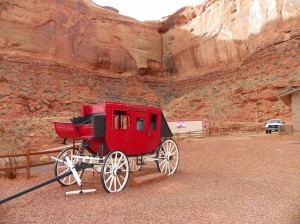
The swarms of tourists came like bees flocking to a new food supply. Only these human insects did not make honey, or contribute to the well-being of the people beyond their money. This is what made me begin thinking again of PTSD. So many common experiences lead me to reflect again on PTSD and its relationship to man’s survival. It is deceptively easy to steal a land or a human spirit. It is a simple recipe – simply take his land; take his dignity; take his humanity, and take his hope. Take his happy memories and replace them with tears and broken lives. By all of the taking, eventually we take his reason for living; we leave behind mangled hearts and broken spirits.
Stealing Spirits is a tragic feat. Preserving them is as necessary as breathing. Each heartbeat is a promise of a new beginning, a new hope, a new and fresh tomorrow – for Spirits are the keepers of our past, our present and our future contributions. They can be shared and nurtured, but they must never be stolen.

Feb
28
BEFORE YOU GO — THANK YOU
Filed Under Tears of a Warrior, Veterans | Comments Off on BEFORE YOU GO — THANK YOU
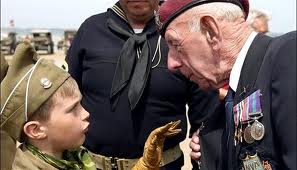 It came in an e-mail this morning. I hadn’t seen it before, which made it all that more special.
Often we have written and spoken about the need to thank our past and current military veterans and families for their sacrifice and service. Their selflessness has offered the rest of us a comfortable and safe way of life that many people in other countries have never experienced. Just listening to the news the last few weeks regarding events in Egypt, Libya, even Morocco have left us even more aware and grateful for the many freedoms and blessings we have as Americans.
To all veterans who have protected our freedoms, we thank you! Thank you again for your dedication to Freedom. Thank You for your service to our country and its people, many who sometimes may seem to forget that while you were in a foreign land fighting, they were home enjoying the comforts of their daily lives.
In defense of the average person, I believe it is not because they don’t care; it is more that you did such an amazing job of protecting our rights and you did it so quietly with humbled humility that few seemed to notice. Yet, for many, gratitude is present deep in the heart if not consciously in the mind.
Therefore, we thought our readers might enjoy this small tribute that touched our hearts and reminded us again how indebted we are to military service.
If you know of someone who has served, make that effort now to say Thank You.
Tomorrow may be too late, so do it “Before They Go”.
Please view and honor the veterans represented in both videos:
WWII & Korean War Veterans
http://www.beforeyougo.us/play_byg
Vietnam War Veterans
http://www.beforeyougo.us/play_byg_vn
Feb
2
A HUMBLED JOY
Filed Under American Patriotism, Civilian life, Combat PTSD, Family, Life, Love, PTSD treatment, Tears of a Warrior, Treating PTSD, War | Comments Off on A HUMBLED JOY
by Janet J. Seahorn, Ph.D
They stood before us, this beautiful, young couple. He had just returned home from a tour in Afghanistan, his second time away. They had many things they could have done that would have been much more fun than taking time to visit with us.
She was a student in my fall semester course at the University. At the beginning of the new semester she let me know her husband would be returning home soon and she wanted Tony and me to meet him. Just the request was a humbled joy. Actually meeting them on that cool winter day even meant more.
During our short time together, we did not talk much about his experiences at war except to listen to a few short phrases indicating he had been in some difficult situations.
I didn’t mention that his wife had to take an “Incomplete” for the college course because she became seriously ill and spent several days in the hospital. Somehow, all of this was now unimportant. The only thing we noticed was how the two people standing before us just couldn’t stop smiling and giggling continually as they held hands, grateful to finally be together.
My goodness, this was truly the picture of humbled joy.
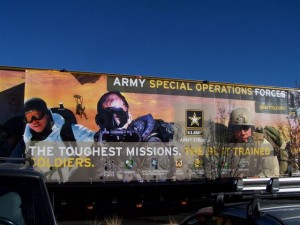
That same day we spoke with an army Special Forces warrant officer who was helping to show students on campus the various skills and equipment used in the military. The young man explained that he had been in the army for sixteen years, joining-up right after high school. Honestly, he didn’t look like he was that old; he smiled widely when I shared my observation with him.
He talked about how joining the military at age seventeen was the best thing he has ever done. The army, he noted, gave him direction, guidance, and supported his development as a confident adult. The interesting detail about our conversation was how much I learned in a short time about his confidence as career military person.
At the beginning of our chat I asked how many times he had been overseas; five – six times if you counted a stint in Romania. The duration of each tour was between three and eight months depending on the mission. During several of his assignments he experienced the reality of war, including several casualties within his unit.
Yet, in spite of the stress, he seemed to be coping with the emotional and physical side effects of combat pretty well. It was challenging, he noted, to reintegrate into “normal” life on each return home, but the army gave him plenty of support and time to decompress.
He pointed out that on several occasions he was given a lengthy mental survey of over 115 items which sometimes highlighted his PTSD tendencies. Nevertheless, because he was career army, his adjustment process appeared to be faster and more comprehensive than veterans who left the service shortly after returning from battle. There does seem to be some significant benefits for the men/women who are in the military long term.
Perhaps being in a community of individuals who have experienced similar battle conditions helps the healing and understanding process. Being around other soldiers who can identify with the pain of combat; others who quietly appreciate the sacrifice of serving our country may lessen the feelings of emotional trauma of being alone in a world where most people haven’t experienced war. This, by itself, would be an immense relief because one wouldn’t have to pretend everything is OK when it isn’t. You wouldn’t have to go through each day feeling lost and alone because there would be a band of brothers surrounding you with knowledgeable support. At any rate, this young soldier certainly gave me some things to think about.
Humbled Joy, invisible, yet real. Thank you.
Jan
26
HIDDEN IN PLAIN SIGHT
Filed Under Combat PTSD, Life, Peace, PTSD, TBI & PTSD, Tears of a Warrior, Trauma, War, Wisdom | Comments Off on HIDDEN IN PLAIN SIGHT
by Janet J. Seahorn, Ph.D
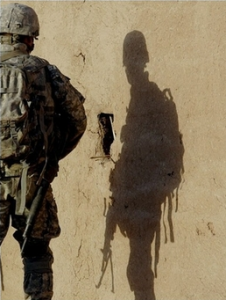
There is a phrase that one hears every now and then, Hidden in Plain Sight. Four simple words that eloquently reveal the complexity of the impact of trauma on one’s mind, heart, and soul. We see the person; we look at the eyes, the body language, the being’s form. The suffering is present in plain sight for all to witness. Yet, few do, lacking the keen observational heart skills required to notice anguish.
There are days I wish I didn’t see it – the faces of children battered by abuse and neglect; the adolescent’s depressive absorption into the ugly world of alcohol and drugs, and the veiled, but ever present ghosts of veterans, young and old carrying their memories of war. They haunt me as the world moves around their pain because it is hidden in plain sight.
Much like ‘Don’t Ask, Don’t Tell’, we are a nation that prefers to maintain our equilibrium at all cost. We tend to be uncomfortable with sorrow even when it stands knocking at our front door asking only for recognition and a bit of compassion.
We say we are a nation of empathy, yet often dismiss the humanity that exists in every person, especially those with whom we don’t agree. We argue we are intelligent, proficient thinkers, yet fight rigorously to disqualify any information that does not align with our personal paradigms/beliefs, whether true or misleading, without accurate evidence or data.
The answers to our current and future problems are available, but for too many they are hidden in plain sight. It will take incredible courage to look into our own minds and hearts searching for what is right and true. It will take courage and honest self-reflection to heal the hidden wounds of the wounded, but it can be done. What lies before us does not need to consume us with fear or apprehension. When confronted, trauma and pain can be overcome and no longer hidden or carried alone.
Light and sunshine are incredible healers.