BOOK PURCHASE: Discount (above) or PayPal (below)
Click "Buy Now" to continue to PayPal
Click to order eBook - Kindle

Click to order eBook - Nook

May
13
PTSD Series Discussion #1
Filed Under Combat PTSD, PTSD, PTSD treatment, TBI & PTSD, Tears of a Warrior, Treating PTSD, War | Comments Off on PTSD Series Discussion #1
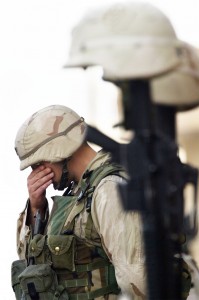 Several weeks ago we were ask to respond to a set of questions regarding Post-Traumatic Stress and combat vets. These responses will be used in a short pamphlet/flip book that will be distributed through another organization. We thought many of our readers might find the questions and our feedback useful. Today’s blog is the first of our five part series. (Part 1 of 5)
•1. How do I know if my serviceperson might be suffering from PTSD? (Symptoms, possibly)
This is a great question with a not so simple answer. Not every person who returns from serving in a war zone ends up with Post-Traumatic Stress. A great deal depends on the amount of time the person spent serving under combat conditions, as well as how many traumatic events occurred during his/her deployment. Most doctors and researchers agree that the more time spent away form home, and the more distressing events experienced during each deployment, the greater the likelihood the person may experience some form of PTSD. If the individual was already predisposed to stressful home or environmental factors before joining the military, PTSD may become even more prevalent. There is no simple formula for why one person develops PTSD while others seem OK. But one thing is certain; it has nothing to do with a lack of strength, courage, or character. Sometimes it is simply the hazard of war due to exposure to unspeakable traumatic events, often in life and death situations.
So what signs might you look for when suspecting someone has PTSD? Since the brain is restructured by every act it experiences, it is sensitive to many good and not so good events. Love, hate, prejudice, kindness, and violence are just a few life experiences. Yet, when the life-threatening events occur over and over again for a long duration of time, or even during one incredibly horrifying event, the mind/brain is seared with the image and emotional feelings become imprinted.
Signs/Characteristics of PTSD:
- ð Hyperarousal and abnormal startle responses
- ð Irritability and/or jumpiness; constantly on guard
- ð Hypervigilance
- ð Nightmares, insomnia, and night sweats
- ð Recurrent traumatic memories or flashbacks
- ð Overwhelming waves of emotions
- ð Survivor guilt
- ð Feeling detached and/or emotionally withdrawn from others
- ð Fragmented sense of self and identity
- ð Panic attacks
- ð Shame
- ð Despair
- ð Lethargic or lack of motivation/interest in life, work, and family
- ð Avoidance of common places, activities
- ð Memory and concentration problems
- ð Sadness and hopelessness about the future
The key here is that a person generally does not have ALL of these symptoms at once. Some come more often than others. One person may have numerous panic attacks, while another may want to isolate himself and not take part in normal daily and family activities. It is the severity and frequency of the symptoms that would suggest a diagnosis of Post-Traumatic Stress.
Apr
14
Here Today and Sometimes Still Here Tomorrow
Filed Under Combat PTSD, PTSD, Tears of a Warrior, Today's War, War | 1 Comment
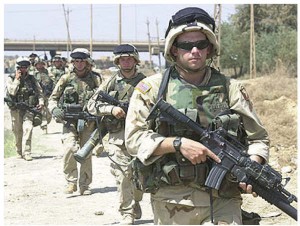
PTSD continues to be everywhere in the news, on TV, and in the movies. The question I have is “Who is listening to all of these stories? Who is concerned about the growing number of new cases resulting from multiple tours of duty in our current wars? Are those in Washington who must attend to severe budget concerns able to do what is necessary? What is right? Is the average American informed enough to care?” Following is information from just one of many data sources on PTSD. It comes from Noel Brinkerhoff (Monday, April 12, 2010), and the information is disturbing.
Nearly 300,000 American troops have served three, four or more times in Iraq and/or Afghanistan, while cases of post-traumatic stress disorder (PTSD) have risen dramatically since the wars began. The possible correlation between these two facts has led to the question of whether it’s fair to send young men and women back into combat again and again, and risk causing long-term mental and emotional problems, not to mention the physical toll.
One U.S. Army study from 2009 found troops in Afghanistan were more vulnerable to developing psychological problems as the number of tours went up (31% for three tours, more than double the rate of those with just one). Another study focused on Iraq showed nearly 15% of Army troops who served two tours suffered from depression, anxiety or traumatic stress; more than double that of a single tour. The PTSD rate was almost 2.5 times higher for two deployments compared with one.
“We just don’t know whether it’s combat exposure, repeated separation from the family or (not enough) time off,” Lieutenant Colonel Paul Bliese, director of the division of psychiatry and neuroscience at the Walter Reed Army Institute of Research, told the Associated Press. “All of those are reasonable explanations.”
Whatever the reason, the ultimate result is that more troops returning home are bringing back with them a whole host of demons and ghosts. These unwanted visitors may never leave the veteran and have significant impact on families, children, and communities. Let us hope that people who can make war decisions are listening, creating effective support services, and making the process as uncomplicated as possible. Let us hope that Americans are willing to provide the physical and mental health funding needed to restore those suffering from combat wounds.
For many families and veterans, the process of getting help becomes so overwhelming difficult that they feel victimized by the very system that should be offering them hope and healing. And let us hope that every politician and every member of our society takes seriously our motto:
If we send them, then we must mend them.
Mar
24
SNOTTY FISH AND PTSD
Filed Under Life, Love, PTSD, Trauma, War | Comments Off on SNOTTY FISH AND PTSD
by Janet J. Seahorn
 This weekend I heard an experienced angler talk about the joys of being in a stream or lake fishing for Snotty Fish. Snotty Fish, he thoughtfully explained, were those fish that were not easy to catch. They were fish that could not be tricked by some ordinary fly or enticing lure. More than likely, such fish had, in some earlier time, been caught before and managed to escape through sheer luck, tenacity, or down right determination. After going through such a traumatic encounter, they were more cautious than most of their finned friends. They understood the consequences of impulsively taking the enticing lure. Therefore, the fisherman who caught (and released) such a Snotty Fish had to be incredibly patient, knowledgeable, and persistent. This particular angler made it clear that catching Snotty Fish was the best and most rewarding way to angle.
Listening to this person talk, I began to comparing how similar Snotty Fish were to veterans who are living with Post-Traumatic Stress. Many of our troops have experienced the traumas of combat. Men and women who have seen and participated in some of humanities worst deeds; deeds that stay etched on the mind and heart. Vets, who when they return to the mainstreams of society, may be unable to trust others, their governments, and even themselves. Yep, Snotty Vets!
Snotty Vets, like Snotty Fish, are often hard to play out. They have experienced lessons in life that few of their fellow countrymen have ever imagined. Such knowledge often makes them wary of their surroundings, including trusting in their own abilities and worthiness. For family and friends, this knowledge can make these Snotty Vets difficult to live with and understand.
Yet, here is the beauty of being in streams with Snotty Vets—they are worth the time and effort to catch and reel back to wellbeing. Health care professionals recognize this fact. Families, friends and communities who walk the path through appropriate support, timely information and love come to empathize with the journey and value the internal strength, courage, and effort that each of them must live out in order to heal.
So you see, Snotty Vets like Snotty Fish are well worth such effort. Simply swimming in their waters help us have greater gratitude for their sacrifice.
Here’s a toast to all of you Snotty Vets, and to all the spouses, children, and siblings of Snotty Vets: “May your new streams be filled with an abundance of peace, joy, and good vigor. May your days bring you fulfillment, and your nights quiet rest. And may you continue to embrace your Snotty strength and leave behind the sorrows of the battlefield. For you are our precious Snotty Vets. We love you. We honor you. And, most of all, we need you to become whole again.”
Mar
2
Honoring Warriors
Filed Under American Patriotism, Events, PTSD, Quilts of Valor | 1 Comment
Veterans
by Janet Seahorn
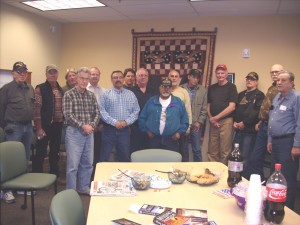
At first it appeared to be an ordinary Thursday evening in mid-February. The soldiers of battles-past gathered at the new Fort Collins Vet Center for their weekly group meeting with the professional VA Staff.
They draw together to heal wounds that occurred long ago in a land far from home. Wounds acquired from serving in Vietnam – a war where few were honored for their personal sacrifice for their country. The veterans meet to try and understand why their scars linger and are still so painful after so many years. And they meet to try and find a sense of recognition of what each has experienced in life – both past and present.
It was on this night that several Fort Collins community members presented a “Quilt of Valor” to those warriors who gave much and were given little in return. Through their generous donations, the community was able to acquire a special hand-made quilt for the presentation.
The quilt was one small way of saying “Thank you for your service and sacrifice”. And, maybe, the quilt would become a symbol of comfort, hope, and honor. This particular comforter was carefully crafted by Donna Roche and the Quilters of Rogers, Arkansas. Her group has assembled and mailed over 700 similar quilts to wounded warriors in hospitals in Iraq, Afghanistan, Germany and the United States. Ms. Roche and her group explain the Quilt of Valor in this manner:
“The Quilt of Valor is our wounded warrior award for service, sacrifice and valor in the line of duty. It is our way of saying “Thank you for your service – you have not been forgotten.” Many caring souls are involved in making the quilts; from contributing quilt blocks, finishing the tops, and integrating each section into the final product. Each special quilt receives a “Quilt of Valor” label thanking the injured warrior for his/her dedication and sacrifice. The label contains the name of those involved in the making of each caring blanket.”
The Quilt of Valor is in fact a symbol of renewal. It transforms the hands of war’s destruction through the caring quilter’s fingers of each blanket’s construction. It shifts the heart from the darkness of combat to the light of a kinder future. And, hopefully it moves the experiences of combat trauma to a quieter sense of peace.
On this Thursday evening, warriors who were never honored finally have their Quilt of Valor. The gratitude in their teary eyes, said it all. Perhaps, after all these years, others do care. Perhaps, there is now a sense of acknowledgement of what these warriors gave without hesitation. You see, it is never too late to say thank you, and the heart is never too old to feel the warmth of such a genuine gesture.
Jan
19
The Nightmare Revisited
Filed Under Life, Peace, Today's War, Trauma, War | Comments Off on The Nightmare Revisited

By Janet J. Seahorn
Last year at this time, Tony and I were in Vietnam and Cambodia. It was a humbling, yet inspiring excursion. As Tony stated many times, he did not go there to heal or recreate the war. He wanted to visit, only to see how things had changed, with hopes that the people and the country were mending.
By all outward appearances hope seemed to be occurring. Yet, what keep coming back to me, were the faces of the old women. We did not see the same number of older men, perhaps because many of this age were killed in the war. The women’s faces were not happy. Their features lined with rivers of anger. It was the eyes that held the emotions, and for many, their emotions were tortuous and hate-filled. What haunts me now are the faces I glimpse in the newspapers of civilians in Iraq and Afghanistan; similar looks living in human bodies experiencing similar horrors of war.
As we continue to read of the escalation of suicides of returning military men and women, I wonder if such unforgettable faces are haunting them. Faces of the enemy, faces of their comrades, faces of the children? In the first few blogs of this New Year, I wrote of Peace. Can it be attained in a person’s mind and heart after experiencing so much? I very much want to believe such a peace is possible. For others, the hideous experiences continue to dig deeper ravines into the soul. To heal, even a bit, these gorges must be filled in gradually.
Perhaps not fully, but even building up the crevasses a little keeps one from falling into the yawning depths of depression, anxiety, and hopelessness. As long as one can look up and see the sky, hope is present. It is when one’s existence is swallowed in darkness that even the tiniest light is diminished. Finding ways to keep the sunlight accessible for our returning vets will be the work of everyone: the nation, its people, families, friends, communities, and most importantly, the veteran.
We have troops leaving daily for the war zone, and others returning. A 2008 Rand Corporation study revealed that 300,000 troops who served in Iraq and Afghanistan had Post-Traumatic Stress, while 320,000 reported probable traumatic brain injuries. Both conditions greatly increase the likelihood of attempted suicide. “According to a Congressional Quarterly compilation in late November 2009, 334 active-duty military service men and women have taken their own lives in 2009” (Edward Pages, 2009: The Year of Soldier’s Suicide), and this does not include those military individuals who have been discharged.
Let us all be sure to look into these eyes of freedom and not dismiss the signs of their sacrifice. Peace and healing is everyone’s work; everyone’s answerability. As a nation, it must be our core mission to mend and heal all those that fought in lands where few of us ever think to venture.
I doubt if many of our returning military personnel have rational thoughts of wanting to return to the combat zone. It took almost forty years for us to do so.
One of our favorite veterans, Michael MacDonald, wrote us the other day relating his response to those who frequently ask him if he ever wants to return to Vietnam for a visit. His reply, “Why, I was just there last night.”
And, for many, this statement is all too true. It is those nights without returning that we pray for in our sleep and dreams. It is those nights without revisiting the nightmares that keep us healing.
Jan
12
Another Perspective on War
Filed Under PTSD, Today's War, Trauma | 1 Comment
by Janet J. Seahorn
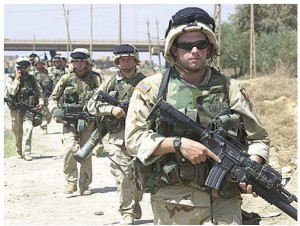
It is a snowy Sunday afternoon. I have been running errands, not because I have a great deal to do after the holidays; to be honest, I am merely trying to keep from thinking about the escalation of the war in Afghanistan. When I got home, Tony had posted a new message on our blog that began with “I seem to spend a lot of time thinking about war, even when I don’t want to. The reality of war. The horror of war…” With this blog he added an article from our local newspaper, The Denver Post. It was another reality check from troops actually involved in war, versus media or political rhetoric.
Every day we get emails, phone calls, or an acquaintance sharing a tragic story about a loved one, friend, or just someone they distantly know who is struggling with Post-Traumatic Stress. For those who have and are serving in the current conflict, the stories are so similar to Vietnam veterans it is down right eerie.
For some individuals the nightmares begin immediately. Others seem OK for the first six months or even a year, and then it begins, the panic attacks, unresolved anger, anxiety, and night terrors. The narratives, however, seem to remain the same. The vet initially attributes the emotions to some external force. He/she claims the feelings aren’t real. Given time, everything will be just fine.
Denial is an interesting strategy and may work for a short time, but sooner or later friends and family members will begin to feel the impact of the warrior’s pain. Owning the trauma is the first step to managing it.
I can’t begin to count how many people who have never served in the military, have never had to sacrifice their physical and emotional lives, have never lived with a parent or sibling who is carrying the war’s trauma in every cell of his body says something like, “there is a silver lining in these wars”, “if we don’t fight them there, we will have to fight them here on American soil”.
It isn’t that these individuals are unkind or uncaring; they merely have not had the experience of combat that comes with a very high personal price tag. The ultimate “Golden Globe of Thoughtlessness”, however, are those who doubt that PTSD even exists, and that if it does, it can be easily treated or overcome with just a little effort and personal fortitude.
OK, I admit, I sound cynical. Perhaps what might appease me a bit is giving all of those “others” a chance to sacrifice a bit of what our veterans are enduring. Perhaps, if the families of those “others” would have to witness and battle the demons in their homes with their loved ones, maybe, just maybe, my irritation would subside a bit. Or, maybe, just maybe, one tour of duty is enough for any warrior.
What I cannot accept is that this current war is being fought by less than one percent of the American population and that one percent isn’t comprised of the well-off and well-to-do. As a country we are passively engaged in a practice that will come to haunt us.
Haunt us as a country; haunt us in our communities; and haunt us as moral beings. For sooner or later, as a nation we will have to face the consequences of our inequitable actions. The price will be expensive and ugly.
I wonder if our country’s leaders and the American people will be willing and able to cover the costs.
Jan
3
A Perspective on War
Filed Under American Patriotism, PTSD, Today's War, War | Comments Off on A Perspective on War
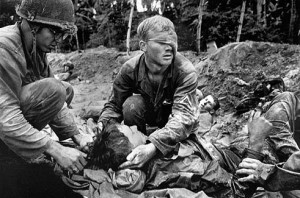 I seem to spend a lot of time thinking about war, even when I don’t want to. The reality of war. The horror of war. What does winning a war really look like? Are war and terrorism even related or is one a symptom of the other?
Following is an article in today’s Denver Post which provides a perspective…
-Tony Seahorn
Fool’s game: A soldier’s lament
By Megan Nix
Posted: 01/03/2010
My friend from Denver, a thirtysomething with a full red beard, a plaid shirt, and a loud, choppy laugh, looks like any guy you might have a drink with to talk about girls or music or the work week.
The last time I hung out with him, we shared a beer stein on Larimer Street during Oktoberfest and talked about Halloween costumes. During a more recent happy hour, we talked about the summons he received to deploy to Afghanistan.
Because of the Army’s Uniform Code, I can’t name him. Suffice it to say he’s the one person in the 30,000 who got that call to whom I can give a voice.
It was Nov. 11, 2009, Veterans Day, when my friend was called back to war. His friends had taken him out to shoot clay pigeons in honor of his being a veteran in Iraq, and when he went to his parents’ house for Sunday dinner, a big envelope was waiting for him. He went down into the basement where his father, a potter, was shaping clay. “I just walked up to him and gave him a hug,” he says, smiling from above the amber glow of his draft beer. Hugs are not something he regularly does. “Then I stepped back, and I said, ‘Dad, I’m going to Afghanistan.’ ”
Like most soldiers, he’s dealing with some of the same symptoms as one of his heroes, Audie Murphy, a World War II vet who publicized the unseen wounds of war. Fear, insomnia, depression, a loss of faith in our country’s leaders, and a nightmarish reluctance to re-enter the world “outside the wire.” Like any young man who’s already been to war once, my friend is doing everything he can in order to not be deployed twice.
When he served in Baghdad, there were four to five American deaths a day, the city was a “cesspool,” and “generals were being moved around like playing cards. People don’t realize how much worse it is than what you see on TV. In a city that goes to war, services stop – sewage, water – there’s very limited law and order. You can’t even imagine how awful the world is when a war is happening there.”
Despite his hearty laugh and recurring shrugs, he exudes disillusionment. We’re nestled in a leather booth, and at the bar, two toothless men start to shove each other against the stools and shout obscenities.
“I bet you,” my war-bound buddy says, “at least one of them is a vet.” It doesn’t matter if they’re vets or not, at least one person here is, and those unseen wounds of war? I can see them in this bar.
“My job in Iraq as a public affairs specialist was to prove, ‘What’s the good here? What’s the silver lining? How can I slant this to look good?'” my friend explains. “If you’re very honest,” he says, with signature honesty and one hack of a laugh, “you could never do it.”
One of the reasons he has agreed to talk to me is so that he can be honest, albeit anonymously. The namelessness seems to fit: Both Iraq and Afghanistan are wars largely stocked with low- to mid-level soldiers on repeated deployment. Soldiers from Nowhereville, U.S.A., young men and women who will die largely unrecognized for being, as my friend says, “some sort of hero.”
He’s not in the business of sugar-coating. Bombs are the best way to kill because no one has to be there, he tells me. He recounts how the fluids on the floor of a walk-in freezer stacked with car bomb victims flowed, tar-black, to a drain under his feet. “Beyond capacity,” is how he describes the scene of the nameless corpses. “Innocent victims of roadside bombs gone wrong. The unwanted. Victims that will never ever be identified.”
My friend’s insights increase with the drinks. He points out that while what we have is called a “volunteer army,” life circumstances are what dictate if enlisting is in a kid’s future. “See those guys?” he points to the two men who have stopped fighting and are staring blankly at their sentinel of empty shot glasses. “If they did serve, I can almost guarantee they came from little money. No Haliburton sons and daughters are dying in Iraq or going to Afghanistan,” he says, pushing his finger into the beer-stained table. “I can’t even tell you how many Army leaders I’ve seen without a combat patch (signaling they’ve been deployed) on their right arm. It just shows you how many people aren’t bearing the weight of this war.”
The weight of his story accumulates like a collection of heavy fragments.
A break for a granola bar on the back of Vehicle 2. A deafening explosion. A puff of smoke where Vehicle 4 had been.
Like many young men who enlist, my friend wanted to be independent of his parents and the military was the best possible solution, so he enlisted five years ago. “I thought if I don’t find anything I’m passionate about, I should go,” he says.
By now, he’s gathered plenty of things to be passionate about. One of them is not returning to Afghanistan. As a technically disabled vet who already did five years, was honorably discharged, and “did everything I was ever asked,” he received the news of his “involuntary mobilization” with reluctance and disbelief. He knew he was subject to recall until June 2012, but opening the envelope was one of those times when you say, “Seriously? I mean, seriously?”
Really, he did more than he was asked to do: He volunteered to fight at a time when he knew he’d likely be deployed. He was stationed in Iraq during one of its bloodiest summers. And, most importantly, he came back.
He also has simpler reasons for not wanting to return: He doesn’t know if he can pick up a 200-plus-pound person. He doesn’t want to carry a weapon. And he doesn’t want to be a pawn in a game of politics if part of the reason the withdrawal is scheduled for 2011 is because President Obama is up for re-election in 2012.
After opening his Afghanistan envelope, my friend immediately called his superior to appeal. “What’s the deal?” he asked. “I cannot do this again.” And the noncommissioned officer on the phone replied: “Look, we are scrounging the bottom of the barrel right now. The bottom of the barrel.”
One of the two men at the bar says he doesn’t have the money to pay for his drinks tonight, stands up from his tattered stool to leave, then sits back down. Someone puts a coin in the jukebox and I’m hoping the song will be happy, but it’s not. Bonnie Tyler’s voice starts in on “Nothing but a Heartache.”
“I only saw the effects of war, not the worst of it,” my quieted friend admits as the song reaches its refrain. “For every war story, there’s a better story not being told. Those go to the grave. Or they’re stories that the people holding them can never begin to relive.”
Tyler croons, “It’s a fool’s game,” while I work on my next beer.
I’m not sure what I should tell this young, smiling and wounded man in front of me. That he’ll be fine and somehow his appeal will be granted, and if not, he’ll come back and we’ll have beers and it will be over. We both know that soon he’ll probably be on a plane with his 60 pounds of gear, looking for silver-lined stories to send back to middle American about the benefits of being at war.
“It’s a heartache,” she sings: “Nothing but a heartache. Hits you when it’s too late. Hits you when you’re down.”
There are many things to thank my friend for, but the only thing I thank him for at the end of the night is his time, and at least that feels like a little bit of sincerity in the midst of everything we’ve both heard and read about our reasons for sending him to Afghanistan. “I’ll see you soon,” I tell him, and the last thing I say – my minuscule gift of acknowledgment – is his name.
The silver lining in this story? I’m still looking for it.
Dec
24
A Christmas Poem Video
Filed Under American Patriotism | Comments Off on A Christmas Poem Video
-Written by Michael Marks
http://www.youtube.com/watch?v=5_P6yU_ymFM
Dec
8
A Different Christmas Poem
Filed Under American Patriotism, Christmas, Life, Today's War | 1 Comment
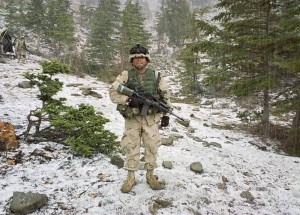
by Michael Marks
The embers glowed softly, and in their dim light,
I gazed round the room and I cherished the sight.
My wife was asleep, her head on my chest,
My daughter beside me, angelic in rest.
Outside the snow fell, a blanket of white,
Transforming the yard to a winter delight.
The sparkling lights in the tree I believe,
Completed the magic that was Christmas Eve.
My eyelids were heavy, my breathing was deep,
Secure and surrounded by love I would sleep.
In perfect contentment, or so it would seem,
So I slumbered, perhaps I started to dream.
The sound wasn’t loud, and it wasn’t too near,
But I opened my eyes when it tickled my ear.
Perhaps just a cough, I didn’t quite know,
Then the sure sound of footsteps outside in the snow.
My soul gave a tremble, I struggled to hear,
And I crept to the door just to see who was near.
Standing out in the cold and the dark of the night,
A lone figure stood, his face weary and tight.
A soldier, I puzzled, some twenty years old,
Perhaps a Marine, huddled here in the cold.
Alone in the dark, he looked up and smiled,
Standing watch over me, and my wife and my child.
“What are you doing?” I asked without fear,
“Come in this moment, it’s freezing out here!
Put down your pack, brush the snow from your sleeve,
You should be at home on a cold Christmas Eve!”
For barely a moment I saw his eyes shift,
Away from the cold and the snow blown in drifts..
To the window that danced with a warm fire’s light
Then he sighed and he said “Its really all right,
I’m out here by choice. I’m here every night.”
“It’s my duty to stand at the front of the line,
That separates you from the darkest of times.
No one had to ask or beg or implore me,
I’m proud to stand here like my fathers before me.
My Gramps died at ‘ Pearl on a day in December,”
Then he sighed, “That’s a Christmas ‘Gram always remembers.”
My dad stood his watch in the jungles of ‘ Nam ‘,
And now it is my turn and so, here I am.
I’ve not seen my own son in more than a while,
But my wife sends me pictures, he’s sure got her smile.
Then he bent and he carefully pulled from his bag,
The red, white, and blue… an American flag.
“I can live through the cold and the being alone,
Away from my family, my house and my home.
I can stand at my post through the rain and the sleet,
I can sleep in a foxhole with little to eat.
I can carry the weight of killing another,
Or lay down my life with my sister and brother..
Who stand at the front against any and all,
To ensure for all time that this flag will not fall.”
“So go back inside,” he said, “harbor no fright,
Your family is waiting and I’ll be all right.”
“But isn’t there something I can do, at the least,
“Give you money,” I asked, “or prepare you a feast?
It seems all too little for all that you’ve done, For
being away from your wife and your son.”
Then his eye welled a tear that held no regret, “
Just tell us you love us, and never forget.
To fight for our rights back at home while we’re gone,
To stand your own watch, no matter how long.
For when we come home, either standing or dead,
To know you remember we fought and we bled.
Is payment enough, and with that we will trust,
That we mattered to you as you mattered to us.
Please, would you do me the kind favor of sending this to as many people as you can? Christmas will be coming soon and some credit is due to our U.S service men and women for our being able to celebrate these festivities. Let’s try in this small way to pay a tiny bit of what we owe. Make people stop and think of our heroes, living and dead, who sacrificed themselves for us.
LCDR Jeff Giles, SC, USN
30th Naval Construction Regiment
OIC, Logistics Cell One
Oct
22
Here’s to the Heros: A Military Tribute
Filed Under American Patriotism | Comments Off on Here’s to the Heros: A Military Tribute
http://www.youtube.com/watch?v=LL-0mdEg0U4