BOOK PURCHASE: Discount (above) or PayPal (below)
Click "Buy Now" to continue to PayPal
Click to order eBook - Kindle

Click to order eBook - Nook

Mar
31
STEALING SPIRITS
Filed Under Combat PTSD, Human Rights, PTSD, Tears of a Warrior, Wisdom | Comments Off on STEALING SPIRITS
by Janet J. Seahorn, Ph.D

Last week we did a ten day road trip through Colorado, New Mexico, Arizona, and Utah. One place we visited was Monument Valley, a beautiful, hauntingly desolate landscape of red sandstone formations rising up from the thirsty valley floor. This region is a sacred Indian worship site belonging to the Dine tribe. Many sacred locations remain private for ceremonies held by Navajo tribes along the Arizona & Utah border.
Although the valley has been open to the public for decades, I still felt reluctant to enter its sacred domain. It felt somehow like I was stealing a small part of the land’s spirit by just being there. This ground is special to the Navajo Nation, a culture that outsiders can never fully understand or appreciate. The beauty of the land itself is breathtaking. The ancient spirits rustle in the wind.
John Ford was the first major director to film his movies in the Monument Valley area. The film, Stagecoach, starring John Wayne won an academy award. Many more successful movies followed, all of which brought money and jobs along with more people to the valley. The many films with their striking scenery contributed to a rise in visitors who wanted to view the landscape first hand.
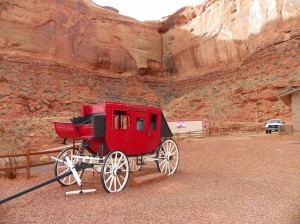
The swarms of tourists came like bees flocking to a new food supply. Only these human insects did not make honey, or contribute to the well-being of the people beyond their money. This is what made me begin thinking again of PTSD. So many common experiences lead me to reflect again on PTSD and its relationship to man’s survival. It is deceptively easy to steal a land or a human spirit. It is a simple recipe – simply take his land; take his dignity; take his humanity, and take his hope. Take his happy memories and replace them with tears and broken lives. By all of the taking, eventually we take his reason for living; we leave behind mangled hearts and broken spirits.
Stealing Spirits is a tragic feat. Preserving them is as necessary as breathing. Each heartbeat is a promise of a new beginning, a new hope, a new and fresh tomorrow – for Spirits are the keepers of our past, our present and our future contributions. They can be shared and nurtured, but they must never be stolen.

Feb
15
WICKED PROBLEMS
Filed Under Combat PTSD, PTSD, PTSD treatment, Tears of a Warrior, Trauma, Treating PTSD, War | Comments Off on WICKED PROBLEMS
by Janet J. Seahorn, Ph.D
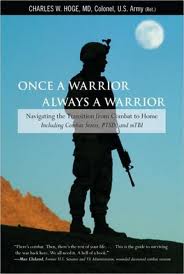
No doubt about it, PTSD is a very Wicked Problem. Wicked Problems, by definition, are those dilemmas that cannot be solved easily by using a typical approach. Anyone living with traumatic stress, especially those pressures caused by combat, will attest to the challenges of trying to solve the predicament of moving through his/her life carrying the memories and phantoms of war. If the solution was easy, it would have been found centuries ago. Yet, here we are today, in 2011, and the Wicked Problem still exists.
One of the Wicked Problems of trauma is surviving the depression that can be a part of the conflict. How does a person live with long-term depression that often becomes the new normal after battle? Constance Gibbons, one of our readers, wrote last week and shared how depression has been the new normal for many vets including her husband. After years of having it a part of their daily being, it becomes their after war identity. She stated: Another interesting aspect from those of us observers – spouses, et al – was that universally we noted the levels of sort of a baseline enthusiasm, whereas, the vet thought they were quite fine.
She explained further: As you continue to think of ‘depression’ as it may be portrayed by the vet, maybe think of a sense of resolution, unknowing acceptance, somewhere in a lower zonal level (between overconfidence and fear) from the years of living on the cusp of life and death, at a level of continuing risk so great that without the impact of the continuing penetration, after, into youthful vulnerability, it appears to those of us in observation to be baseline depression…where it is not to the vet; just an absence of heightened stimulation. Wow, now how would anyone solve such a Problem?
Veterans carry many Wicked Problems – ghosts of death and shocks of battle, memories that make if difficult to stay grounded in every day activities, and struggles to avoid the sleepless nights where staying awake is one way to keep the dreams of foreign battles from returning. New therapies and medications have helped lower the impact of PTSD but it has not solved the Problem. I read many blogs and articles relating combat PTSD to the trauma that the average person might experience. Things such as car accidents, rape, assault… all which are terrible and difficult to cope. Yet, these are hard to compare to combat where trauma occurs every day, often numerous times in a day. One of the biggest differences is besides being the prey, in combat you must also become the predator. Instead of being involved in one brutal injury or death, you may experience many.
Fighting the Wicked Problems of war takes work. It requires listening to your gut feelings as well as how others around you perceive your behaviors. The good fight involves muffling the loud voices in the head long enough to examine realistic solutions. Perhaps there will be no absolute solution to PTSD, but every day there are warriors who conquer their demons and live full and meaningful lives. Wicked Problem you may remain, but you will not take more of a warrior’s life than you already stole. You will not win this internal war, even if you succeed in taking an emotional battle now and then. You see, Wicked PTSD Problem, in spite of your persistent, you are no match for the courage and willpower of a WARRIOR.
Feb
2
A HUMBLED JOY
Filed Under American Patriotism, Civilian life, Combat PTSD, Family, Life, Love, PTSD treatment, Tears of a Warrior, Treating PTSD, War | Comments Off on A HUMBLED JOY
by Janet J. Seahorn, Ph.D
They stood before us, this beautiful, young couple. He had just returned home from a tour in Afghanistan, his second time away. They had many things they could have done that would have been much more fun than taking time to visit with us.
She was a student in my fall semester course at the University. At the beginning of the new semester she let me know her husband would be returning home soon and she wanted Tony and me to meet him. Just the request was a humbled joy. Actually meeting them on that cool winter day even meant more.
During our short time together, we did not talk much about his experiences at war except to listen to a few short phrases indicating he had been in some difficult situations.
I didn’t mention that his wife had to take an “Incomplete” for the college course because she became seriously ill and spent several days in the hospital. Somehow, all of this was now unimportant. The only thing we noticed was how the two people standing before us just couldn’t stop smiling and giggling continually as they held hands, grateful to finally be together.
My goodness, this was truly the picture of humbled joy.
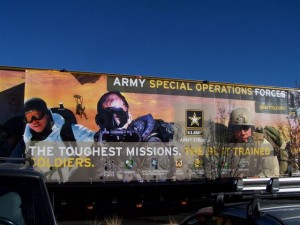
That same day we spoke with an army Special Forces warrant officer who was helping to show students on campus the various skills and equipment used in the military. The young man explained that he had been in the army for sixteen years, joining-up right after high school. Honestly, he didn’t look like he was that old; he smiled widely when I shared my observation with him.
He talked about how joining the military at age seventeen was the best thing he has ever done. The army, he noted, gave him direction, guidance, and supported his development as a confident adult. The interesting detail about our conversation was how much I learned in a short time about his confidence as career military person.
At the beginning of our chat I asked how many times he had been overseas; five – six times if you counted a stint in Romania. The duration of each tour was between three and eight months depending on the mission. During several of his assignments he experienced the reality of war, including several casualties within his unit.
Yet, in spite of the stress, he seemed to be coping with the emotional and physical side effects of combat pretty well. It was challenging, he noted, to reintegrate into “normal” life on each return home, but the army gave him plenty of support and time to decompress.
He pointed out that on several occasions he was given a lengthy mental survey of over 115 items which sometimes highlighted his PTSD tendencies. Nevertheless, because he was career army, his adjustment process appeared to be faster and more comprehensive than veterans who left the service shortly after returning from battle. There does seem to be some significant benefits for the men/women who are in the military long term.
Perhaps being in a community of individuals who have experienced similar battle conditions helps the healing and understanding process. Being around other soldiers who can identify with the pain of combat; others who quietly appreciate the sacrifice of serving our country may lessen the feelings of emotional trauma of being alone in a world where most people haven’t experienced war. This, by itself, would be an immense relief because one wouldn’t have to pretend everything is OK when it isn’t. You wouldn’t have to go through each day feeling lost and alone because there would be a band of brothers surrounding you with knowledgeable support. At any rate, this young soldier certainly gave me some things to think about.
Humbled Joy, invisible, yet real. Thank you.
Jan
26
HIDDEN IN PLAIN SIGHT
Filed Under Combat PTSD, Life, Peace, PTSD, TBI & PTSD, Tears of a Warrior, Trauma, War, Wisdom | Comments Off on HIDDEN IN PLAIN SIGHT
by Janet J. Seahorn, Ph.D
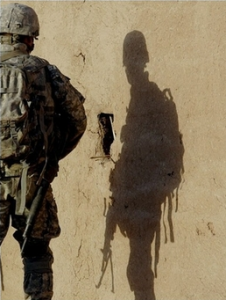
There is a phrase that one hears every now and then, Hidden in Plain Sight. Four simple words that eloquently reveal the complexity of the impact of trauma on one’s mind, heart, and soul. We see the person; we look at the eyes, the body language, the being’s form. The suffering is present in plain sight for all to witness. Yet, few do, lacking the keen observational heart skills required to notice anguish.
There are days I wish I didn’t see it – the faces of children battered by abuse and neglect; the adolescent’s depressive absorption into the ugly world of alcohol and drugs, and the veiled, but ever present ghosts of veterans, young and old carrying their memories of war. They haunt me as the world moves around their pain because it is hidden in plain sight.
Much like ‘Don’t Ask, Don’t Tell’, we are a nation that prefers to maintain our equilibrium at all cost. We tend to be uncomfortable with sorrow even when it stands knocking at our front door asking only for recognition and a bit of compassion.
We say we are a nation of empathy, yet often dismiss the humanity that exists in every person, especially those with whom we don’t agree. We argue we are intelligent, proficient thinkers, yet fight rigorously to disqualify any information that does not align with our personal paradigms/beliefs, whether true or misleading, without accurate evidence or data.
The answers to our current and future problems are available, but for too many they are hidden in plain sight. It will take incredible courage to look into our own minds and hearts searching for what is right and true. It will take courage and honest self-reflection to heal the hidden wounds of the wounded, but it can be done. What lies before us does not need to consume us with fear or apprehension. When confronted, trauma and pain can be overcome and no longer hidden or carried alone.
Light and sunshine are incredible healers.
Dec
15
A Different Christmas Poem
Filed Under American Patriotism, Peace, Tears of a Warrior, War | Comments Off on A Different Christmas Poem

We included this in last year’s blog. Here it is again.
The embers glowed softly, and in their dim light,
I gazed round the room and I cherished the sight.
My wife was asleep, her head on my chest,
My daughter beside me, angelic in rest.
Outside the snow fell, a blanket of white,
Transforming the yard to a winter delight.
The sparkling lights in the tree I believe,
Completed the magic that was Christmas Eve.
My eyelids were heavy, my breathing was deep,
Secure and surrounded by love I would sleep.
In perfect contentment, or so it would seem,
So I slumbered, perhaps I started to dream.
The sound wasn’t loud, and it wasn’t too near,
But I opened my eyes when it tickled my ear.
Perhaps just a cough, I didn’t quite know,
Then the sure sound of footsteps outside in the snow.
My soul gave a tremble, I struggled to hear,
And I crept to the door just to see who was near.
Standing out in the cold and the dark of the night,
A lone figure stood, his face weary and tight.
A soldier, I puzzled, some twenty years old,
Perhaps a Marine, huddled here in the cold.
Alone in the dark, he looked up and smiled,
Standing watch over me, and my wife and my child.
“What are you doing?” I asked without fear,
“Come in this moment, it’s freezing out here!
Put down your pack, brush the snow from your sleeve,
You should be at home on a cold Christmas Eve!”
For barely a moment I saw his eyes shift,
Away from the cold and the snow blown in drifts..
To the window that danced with a warm fire’s light
Then he sighed and he said “Its really all right,
I’m out here by choice. I’m here every night.”
“It’s my duty to stand at the front of the line,
That separates you from the darkest of times.
No one had to ask or beg or implore me,
I’m proud to stand here like my fathers before me.
My Gramps died at ‘ Pearl on a day in December,”
Then he sighed, “That’s a Christmas ‘Gram always remembers.”
My dad stood his watch in the jungles of ‘ Nam ‘,
And now it is my turn and so, here I am.
I’ve not seen my own son in more than a while,
But my wife sends me pictures, he’s sure got her smile.
Then he bent and he carefully pulled from his bag,
The red, white, and blue… an American flag.
“I can live through the cold and the being alone,
Away from my family, my house and my home.
I can stand at my post through the rain and the sleet,
I can sleep in a foxhole with little to eat.
I can carry the weight of killing another,
Or lay down my life with my sister and brother..
Who stand at the front against any and all,
To ensure for all time that this flag will not fall.”
“So go back inside,” he said, “harbor no fright,
Your family is waiting and I’ll be all right.”
“But isn’t there something I can do, at the least,
“Give you money,” I asked, “or prepare you a feast?
It seems all too little for all that you’ve done, For
being away from your wife and your son.”
Then his eye welled a tear that held no regret, “
Just tell us you love us, and never forget.
To fight for our rights back at home while we’re gone,
To stand your own watch, no matter how long.
For when we come home, either standing or dead,
To know you remember we fought and we bled.
Is payment enough, and with that we will trust,
That we mattered to you as you mattered to us.
Nov
23
Humility & Bravery Visible
Filed Under Combat PTSD, Life, PTSD, PTSD treatment, Tears of a Warrior, Treating PTSD, War | 2 Comments
by Janet J. Seahorn, Ph.D
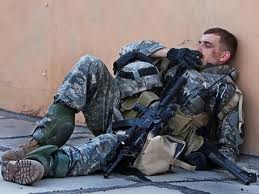
The day was wet and overcast.
Upon arriving at the VA Hospital in Denver, we noticed how many patients seemed to be waiting for a bus or a taxi. Tony didn’t appear overly eager to walk into the building. Just looking at the entrance from the outside made him nervous. Walking inside was even worse. Almost forty years ago, this was the place he went to get help for the nightmares and panic attacks he was experiencing after returning from Vietnam. A young therapist at the time, untrained and unskilled in working with military personnel thoughtlessly told him to be grateful he made it home, and get on with his life. For thirty years, Tony never went back there… or anywhere else for assistance.
Thank goodness we now have a verifiable diagnosis of these frightening memories; it is PTSD, and veteran centers across America are far more proficient in caring and supporting our wounded troops. Nevertheless, Tony had not been back to the Denver VA Hospital until Monday. We were going to talk with troops in the PTSD Unit of the hospital. This is a seven week program where vets get intensive counseling and treatment for their combat traumas. Today there are nineteen men attending the afternoon discussion. Humility can’t quite describe what we feel when we do such meetings.
The majority of the vets were from the Vietnam era with the remaining members from Iraq and Afghanistan. I am pretty sure most people have little understanding of how much suffering each patient has survived; years of torment and silent screams. Each face revealed a unique map of torment. It appeared that every wrinkle held its own story, its own remembrance. Yet, it was the younger warriors who made the most emotional impact. Perhaps this was because they reminded us of our sons. Or perhaps, we were too familiar with the pain they were experiencing and the long journey still ahead. Youthful faces were not yet lined with creases, though their eyes held an even deeper look of anguish. Yesterday’s combat field was not that far from today’s reality. Time had not yet put any distance from the rawness of war. Where several Vietnam vets were willing to talk, the young fighters stayed silent.
At the end of the afternoon, one young marine told me how difficult it was for his mother to understand what was happening to him. He talked about how she just kept saying, “Why don’t you just get better? Why aren’t you back to your old self? You weren’t wounded, what is the matter with you?” and then he said sadly, “she told me, why can’t you just take a pill and be OK?” Then he quietly stated, “I’m trying’ I’m really trying, but I just can’t seem to forget, no matter how hard I try.”
It was heartbreaking to watch him describe his situation. First he endured the many horrors of combat. When he came home, he had to endure the unawareness of the “ordinary” people.
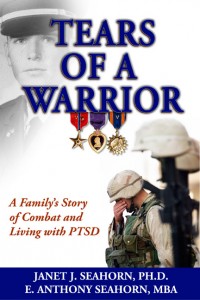
Next, there was the tall, thin youth who sat shifting in his chair seeking a more comfortable position. His back pain was obvious, especially when he cautiously walked bracing his weight with his cane. The sweetest, shyest smile spread over his face as he approached. What he requested was an extra copy of our book, Tears of a Warrior. He wanted to send it to his wife, hoping she might read it before he returned home from the hospital. Perhaps she would gain a better understanding of his condition. Perhaps, by understanding, she would be able to bear the years ahead. Perhaps together they might make it though the dark times still to be faced.
More than ever, I am touched by the courage the young and the old veterans demonstrate. A valor that leads them forwarded searching for a small bit of peace. By making that huge leap of faith to enter this seven week program, they lay bare their demons, hoping by exposure to the light these may leave, or at least become less frightening. For most, I believe this will be true.
Like in combat, sometimes to survive, one must rush towards the enemy fighting with every ounce of power he/she possesses. Healing requires that same force of power – rushing towards the demons, lets them know you no longer will run from them. When the hiding ends the healing begins.
Have a healthy and Happy Thanksgiving.
Nov
14
REMEMBERING VETS
Filed Under American Patriotism, Family, Peace, PTSD treatment, Tears of a Warrior, Veteran's Day, War | Comments Off on REMEMBERING VETS
by Janet J. Seahorn, Ph.D
It is cold outside.
I just got home from my last lecture session. Needless to say it was quite interesting as the entire week I have been battling a bad cold and struggling with losing my voice.
Today, there was no voice. Trying to deliver a lecture with laryngitis is a challenge. Hence, I put all of my “words” on my wonderful PowerPoint and proceeded with the lesson.
Since the week is Veteran’s Day week, I decided I would do something different for my university classes. I would talk about the LITERACY of WAR: the vocabulary, the literature, the stories, and of course, the effects of war on both the veteran and the families.
My first slide said this:
My husband is a Vietnam veteran who was a young officer and served in the jungles between the borders of Cambodia and Vietnam. He witnessed a great deal of bloody battles and lost many men. He has two Purple Hearts. The last one he received after being severely wounded. Out of 130 men, only 19 walked away without any injuries. The rest were either killed or wounded. Yesterday I asked if he would like to be the guest speaker for today’s class since I have no voice. His response is what he said he would tell you,
“My wife thinks I’m not miserable enough, so she wants me to talk about PTSD for 90 minutes.”
He said some other things he might share with you, at which time I decided his services would not be needed! (I would like to keep my job.)
Of course my students thought this was pretty funny, even if it was true. But the purpose of this blog is to share with you what I learned from my students. It is pretty sobering.
Out of 140 students, only five had ever had a college session where the professor talked about or honored veterans on Veteran’s Day.
Most students were interested in the session’s information and videos. A few, however, during the first short video paid more attention to their text messages than to the video. Then I put on a slide, “How well did you listen and honor our veterans during the show?” The room was incredible still. The other short clips received 100% of their attention.
- Young people are not insensitive to veterans, I believe their seeming thoughtlessness is not that at all… it is because the adults around them do not take the time to talk WITH them, or to REMIND them of the sacrifices others have made FOR them. Schools, communities, and parents are the ones most at fault. Many have lived the experience and stayed silent. No longer will I remain soundless. I will always give this presentation in the coming years.
- We did an activity where students moved forward when I asked a question if a relative had served, was injured, or died in a particular war. Many took a step when I mentioned WWII. More stepped forward again when I mentioned Vietnam. And last, when I asked about the Iraq/Afghanistan conflict, I was surprised at how many were impacted. Last, I asked for those who had or were currently serving in today’s wars, four stepped forward. I had them face the class so all would see. Then I began clapping and the entire class gave these four young men a standing ovation for their service. It was an emotional moment for everyone.
At the end of class two of the young men commented that this was the first time anyone had acknowledged and thanked them for their service. Today was the first of what I hope will be many. And just as important 140 young people may stop every now and then, think about those who gave and are giving so much, and say a prayer of gratitude.
Perhaps, when they see a vet or know of a family member who has served they will say Thank You.
A few have already called home and done just that.
Oct
27
NOT YET, NOT YET
Filed Under Black Lions, Combat PTSD, Family, PTSD, Trauma, Vietnam Reunion, War | Comments Off on NOT YET, NOT YET

“Not yet, not yet.” These were the words a mother of a soldier who returned from war with severe, incapacitating PTSD composed to her son’s commanding officer almost forty years later. The mother wrote from a voice in heaven, as if her son had died, because in many ways he had – died emotionally; died cognitively; and died in spirit. Years had passed and she wanted his leader to know how much her son admired the man. How much he believed the officer had done everything possible to prevent the ambush that cost the lives of sixty-four troops. A dispensation of grace, for through her son’s stories, the mother realized how much trauma and burden the officer must be carrying from such a massive loss of life.
Even after four decades the pain and memories still persist as if the battle had just occurred. I am left to wonder how long a human being must or can endure such heartache. Being in charge of the lives of others is an incredible responsibility. A responsibility that makes losing those he led more devastating. One death would have been terrible, but sixty-four is beyond measure.
We heard the story while attending a reunion of the Black Lions who served in Vietnam. The get-together was a relatively small gathering compared to many war reunions. Small because the Black Lions were an elite unit of soldiers who traveled light both in men and equipment. And smaller still because so many had died during the many jungle encounters with the enemy.
Almost every survivor had a story and every attendee had an inner strength that somehow allowed him to live forward each day until now. I only hope that at this point, the time that remains in these old warrior lives can be lived with great joy, peace and personal forgiveness if needed. Our veterans deserve a bit of these gifts and so do their families. So when the mother wrote, “Not yet, not yet,” meaning… do not leave this earth too soon, the same words persist, “not yet, not yet”, the time for personal healing is now!
Blessings and God Bless our vets young and old.
Oct
12
Dang – These Stats Are Amazing
Filed Under Black Lions, Combat PTSD, Life, PTSD, TBI & PTSD, Tears of a Warrior, War | Comments Off on Dang – These Stats Are Amazing
by Janet J. Seahorn, Ph.D.
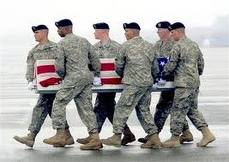
As you might imagine, we have been doing research and accumulating multiple types of data for well over ten years. Much has been on PTSD along with statistics on various numbers of vets who served in different wars, as well as their injury and death counts.
Over the last two weeks we have had numerous individuals send us a variety of articles and information on the Vietnam War. Perhaps the most startling was a number that I checked out through several sites; it was a number that claimed only 1/3 of veterans who served in Vietnam are still alive. This number was part of a 2000 census count, so I can only assume the number is far lower ten years later. The actually statement was “Of the 2,709,918 Americans who served in Vietnam, less than 850,000 are estimated to be alive today”.
Yikes. This is a number neither Tony nor I ever expected. Perhaps we don’t want to admit that we are growing that much older. Or perhaps the numbers may show an underlying concern with the health of Vietnam vets who endured massive amounts of toxic chemicals while serving in the war zone. At any rate, the small number of Vietnam vets still living is a real worry.
Another statistic that we have seen is that of the 9,087,000 military personnel who served from August 5, 1964 – May 7, 1975, only 2,709,918 actually served in Vietnam. Of those who were in Vietnam, only around “40-50% either fought in combat, provided close support or were at least fairly regularly exposed to enemy attack” (Bob Beavis, 2010).
And most alarming in a 1995 census around 9.5 million individuals falsely claimed that they had served in Vietnam when they had not; in the 2000 census almost 14 million individuals falsely made such a claim. Yikes, no wonder the Veteran’s Administration is having a harder time trying to identify who did and did not serve when there are so many “false” claimants in America. As my grandmother would say, “Shame, shame, on all of them”.
Last, and this I find very interesting given the amount of press that has been given to the number of Vietnam vets who were supposedly alcoholics, drug users, and homeless, according to various vet sources (VFW Magazine, the Public Information Office…) there was/is no difference between those populations who served in Vietnam and those who did not.
Also, we often hear about how many Vietnam vets ended up in prison… simply not true. Vietnam vets were less likely to be in or served time in prison – only ½ of one percent (Bob Beavis). Over 82% of Vietnam veterans seemed to have made a pretty successful transition to civilian life in spite of dealing with severe injuries and PTSD.
So congratulations all you Vietnam vets; you have lived a truly exceptional life, served your country with honor, and had the incredible strength and internal courage to continue to live life with high principles and personal pride.
Sep
28
SUICIDE: DID YOU KNOW?
Filed Under Combat PTSD, Life, PTSD treatment, Tears of a Warrior, Trauma, Treating PTSD, War | 1 Comment
by Janet J. Seahorn, Ph.D
Did you Know:
·
Suicide is one of the leading causes of death in America. Every year it takes more lives than auto accidents.
· Suicide impacts kids as young as five and as old as ninety-five.
· The rate of suicide in the armed forces continues to grow with each deployment.
· Current statistics show an active-duty suicide every 36 hours – 18 veterans a day dies by their own hand (Lily Casura, Napa Valley Register, 9/19/2010).
· Women vets are two – three times more likely to commit suicide than non-veteran women (American Psychiatric Association)
· Suicide is more than an emotional state; it is a physical condition as well.
· Depression is treatable… suicide is not —– the final step has already been taken.
Combat is an unhealthy enough challenge. Yet, when a veteran returns home, the struggle may be even worse. Worse because there are fewer people to talk to who understand what he/she has gone through. Worse because during combat one didn’t always have time to think about the horrors of war; now at home, there is often too much time to think. And worse, because depression of any kind is a hidden desperado that becomes a very real physical condition, few understand and address the issue.
In so many cultures, including American, we have been led to believe that depression is something that is strictly emotional. Something that we can easily get over if we just put our “minds” to it. It invades every cell of the body. It steals the good hormones such as serotonin, endorphins, dopamine… and replaces them with a whopping dose of cortisol – one of the stress hormones that cause fight, flight, or freeze. Unfortunately for many, the way one may must fight or fight depression is suicide.
One reason this issue is so important to me is it hits close to home. In the city of Fort Collins, Colorado, suicide has already been the cause of over 39 deaths this year – far more than those who die in traffic accidents. One of those statistics was a close friend of a student in my university class. Imagine sitting in class and getting a text message stating your close friend has taken her life. When I was teaching middle school many years ago, a wonderful young man decided to end his life before he ever had a chance to begin his life. His parents were certain their child’s death was an accident, even though evidence indicate the young man made three different attempts at ending his life before one finally worked.
It is important we all know more about this topic, Suicide. Like any enemy, the more we know about our opponent, the better we can fight the battle and win. So I’ll end with one of my favorite quotes by Emily Dickinson, “Not knowing when the dawn will come, I open every door.” Try to keep opening new doors; sunshine is waiting behind one of them.