BOOK PURCHASE: Discount (above) or PayPal (below)
Click "Buy Now" to continue to PayPal
Click to order eBook - Kindle

Click to order eBook - Nook

Nov
7
TRACES
Filed Under Aging, Fall, Healing, Hope, Life, PTSD, Tears of a Warrior | Comments Off on TRACES
by Janet J. Seahorn, Ph.D

It’s Fall and the woods are filled with brilliant colors of changing leaves, from yellows the color of pure gold, reds that stir the imagination, and oranges that remind me of a Harvest moon. The flushes of hues aren’t the only splendor of Fall; the pungent odors alert our senses that summer is over and winter is ready too soon to cover the ground. It is almost as if the forests entire existence waits for this one time of year to celebrate all that has come before. With all of these physical signs, I got to thinking of the traces we leave behind as we journey through our days. What are the colors of our fallen leaves?

If we are able to overcome all of life’s hardships; if we are able to embrace both the joys and sorrows, perhaps we will leave a special trace of humanity in the world. If we are able to feel a deep sense of gratitude for our being; if we are able to feel a sense of grace even while enduring horrible tragedies; and if, through all the anguishes, our hearts are not given to bitterness but can still remain open to humankind, perhaps we will leave traces of hope and courage.

Hiking the high mountain trails, the paths are covered with fallen leaves. It is as if we are truly on the “yellow brick road”, only this road doesn’t lead to a wondrous wizard. This road really leads back to us, for we are the real wizards of our life. There are no magic spells we possess to bring us more happiness and fewer challenges. No magic wand changes our predicaments or instantly showers us with extra money. You see the true magic is always how we choose to view each moment we live and what we give to others. The magic is not how much material STUFF we have, but how much of ourselves we share with others.
As warriors and families caring for wounded bodies and spirits our lives continually leave marvelous traces for others to view and possibly follow. We bequeath a conviction that determination to move forward and faith to move beyond the hopelessness is achievable. Every time one of our vivid leaves tumbles to the ground, we shower those around us with traces of optimism. Therefore, as we move through our time on earth, we should think about the traces we are leaving behind for others to glimpse and ask, “Are these the traces we want to leave”? Hopefully, our answer is, “Yes”. And maybe we are able to do so because we have been fortunate to follow the traces those before us have left for us to further pursue.

Oct
31
STRENGTH OF SPOUSES
Filed Under Combat PTSD, Healing, Spouse, Stress, TBI & PTSD, Tears of a Warrior, Trauma, War | Comments Off on STRENGTH OF SPOUSES
by Janet J. Seahorn, Ph.D

In the past few years, I’ve written countless blogs on the strength and endurance of our veterans. However, the other side of that coin is the strength and endurance of their spouses. Several days ago we received an e-mail from a spouse who had heard about us and our book through an article that appeared as a Wyoming magazine article. She wrote about the challenges of married life with her veteran husband. A situation that became even more desperate after he suffered a traumatic brain injury (not from combat) that she wrote, “took him totally out of commission”. The e-mail went on to describe how other people did not see the depth of his many wounds, but she was faced with them daily enduring aggressive behaviors and foul language.
The injury occurred in 1998, but it was not until 2001 that the situation became too difficult to bear. I was his sole caregiver & therapist. When things got bad, I was the human standing in front of him as his anger came out.

… There were many days of not sleeping and warding off his craziness. In the first two years after his head injury, we almost lost the house twice. We literally lived in a wooden tent – the house was emptied out of furniture and appliances as the sheriff’s department kept impounding our possessions because we couldn’t pay our bills – possessions which ended up on the court house steps selling for $1. My daughter and I sought safe shelter six times in those two years to get away from him and his outbursts – the first time was on her 10th birthday.
One may think, wow, this sounds pretty darn extreme, yet, due to the lack of available resources in her area, obtaining services was nearly impossible. Her state of affairs is not unlike many of our returning military people and their families. Many spouses are drained of energy trying to keep their loved one out of jails and mental health institutions. What makes her story even more thought-provoking is her educational credentials, during all the turmoil she went back to school and obtained a Master’s degree in mental health. Yet, she has had to fight her own demons brought on by the many years of being exposed to an unpredictable and toxic home environment.
With her educational background she states, I have dissected trauma and I understand the roots of it more than most people.
And perhaps, her most profound statement,
Unfortunately, the war doesn’t stop when they come home. They never leave the ambush; it can haunt them for the rest of their lives. They are eventually removed from the war situation and are not confronted with that type of environment every day (other than their memories). Their spouses and children aren’t so lucky. They too have to live with the aftermath of war.
Thank you, Carol, for your introspective thoughts, your daily courage, and your persistence to keep going even when it would be easier to give up. You are certainly one of our country’s many amazing military spouse.

Sep
5
RENEWAL
Filed Under Tears of a Warrior | Comments Off on RENEWAL
by Janet J. Seahorn, Ph.D

The other day, while on my morning walk, I noticed a band of swimmers in the middle of the lake. Interestingly, I hadn’t been aware of this group before now. Yet, as they swam I saw that each swimmer had attached to their body a florescent orange, buoy-like inflatable that followed their every movement. The more I reflected on this object, the more I came to see that the balloon was both a visual to alert boaters who might be in the area as well as a safety device that would give the person something to keep them afloat if they should incur some other problem while in the water.
So what in the heck does this scenario have to do with Renewal? First, as we move forward in life it is much safer to do it with others to support our journey. Secondly, there most definitely will be times when we get some pretty severe “cramps” or “tremors” which are more like tsunamis of the body, soul, and spirit. There may be times in our life when the darkness seems so black that it is difficult to believe that any light really exists. The darkness becomes a too familiar pattern. Like an old pair of shoes or worn t-shirts, easy to slip into – often beyond practical wear.
When we become aware that such patterns are not serving our needs correctly, it is hard to release these old familiar practices. They may have served our past necessities, but now it is time to move forward. Start small by asking what Renews us each day. Maybe it is simply a brilliant sunrise, a child’s smile, a puppy’s clumsiness, or a strong cup of coffee. The point is this, as human beings we were never meant to stay stagnant. The old saying, if something isn’t growing in some way, it is probably dead – or close to it, therefore being in the land of inaction is not the vacation spot we want to visit too often. As long as we are breathing, we can be in the process of renewal. It is a choice. Not always an easy choice, but nevertheless, a choice. It requires consciously choosing to release those old shoes and worn t-shirts; releasing former negative actions or thought patterns that are devastating our opportunities for peace of mind, heart, body, and spirit.

The question is this — are we ready to do some shopping? Let’s picture ourselves in new apparel. Let’s trust that we are ready and worthy of our new garb. Renewal is a way to bless ourselves in order to be a blessing to others.
Oh, and don’t forget to bring along your florescent orange buoy.

Aug
14
WHEN NEEDED, CHOOSE PERSISTENCE
Filed Under Tears of a Warrior, Troops, War | Comments Off on WHEN NEEDED, CHOOSE PERSISTENCE
by Janet J. Seahorn, Ph.D

What is it that keeps someone going when everyone else seems to be giving up? We hear about such individuals on television, read about them in magazines, and if we are really lucky, we even know a few personally. When trying to put together some common traits of these resolute beings, it is interesting to see what it is that keeps them going.
For some it is religion; a deep faith in a higher source that is walking the journey of a demanding life with them. For others it is more about spirit than religion – spirit being defined as the vital force that characterizes a human being as being alive or a sense of self and energy. Yet, for many it is as simple as living for a cause that is greater than the personal comfort of the self. The vast amount of veterans we have been around have a profound abundance of this trait. Perhaps living beyond oneself came as a result of serving their country even when it meant the possibility of death, bodily injuries, and emotional distress.
In combat, soldiers woke up every morning to face a foe that was ever present. Seeing the price of war and dealing daily with personal losses was a constant of their battle experience. There was no such thing as giving-up or giving-in because it meant that it would let their fellow troops down.
Perhaps the greatest battle for many is when they return home. The challenge of trying to reintegrate into a community which has essentially been isolated from war. Families, spouses, children, friends, coworker – most are truly grateful for the warrior’s sacrifice. We try to understand, to be patient and encouraging, yet, there is absolutely no way any of us who have not been in a combat situation can fully comprehend such devastating experiences.
Therefore, choosing persistence is an option that allows the person to move forward. It is a choice that the vet must make every day. It is a choice that spouses, children, families, and friends must make every day. And it is a choice that Winston Churchill proposed in his statement… “Never give in, never, never, never — in nothing, great or small —- never give in except to convictions of honor and good sense.”
And this is the true essence of persistence. And last, a very special quote from Winnie the Pooh,
Promise me you’ll always remember: You are braver than you believe,
And Stronger than you seem,
And smarter than you think.
(A.A. Milne)

May
7
A TIME TO REFLECT
Filed Under Tears of a Warrior, Today's War, Trauma, War | Comments Off on A TIME TO REFLECT
by Janet J. Seahorn, Ph.D

It has been some time now since we heard the disturbing news of the young sergeant who massacred civilians inAfghanistan. According to the media, the individual has been indicted with killing seventeen people, nine of whom were children.
During this time I debated whether or not to broach the subject in our blog. Truthfully, I’m still not certain I want to bring this up again given the enormous amount of media attention. Yet, it seems important to at least give some perspective on what others have been sending us through phone calls, e-mails, etc.
No one would dispute that what occurred was inexcusable. The entire incident is pretty disturbing. However, I continue to wonder who, beside Sergeant Bales is answerable for this horrendous act? Where is the government’s responsibility in choosing to commit our country to two wars yet refusing to enact a draft? Where is the government’s moral accountability in allowing less than 1% of our young men and women and their families to shoulder the enormous burden of continual deployment and redeployment four, five, and six times to various combat zones? Where is the military’s obligation in making sure each troop is in top physical and emotional health before ever being sent back to a war when he/she may not be fully combat ready? And lastly, where is the conscience of each and every American citizen who allows so few to serve in combat and bear the burden of an entire country?
Please understand, I am not trying to be critical, but it is crucial that every aspect of this terrible situation be carefully examined. For you see, these are questions we should all be asking if we are going to do better in the future. Because, unfortunately, in our future there will still be wars. What are the lessons to be learned?
In reality, Sergeant Bales is morally, legally, and physically accountable for this terrible deed. He cannot use the argument of having PTSD as the sole contributor for his actions. Millions of past and present veterans have and are suffering with this condition. Yet few ever commit such violent and unforgivable acts. No, according to what we are being told, these murders were committed by Sergeant Bales for reasons yet to be disclosed. However, each of us must question, who else should bear the consequence of such horrific actions? Are we as a nation pushing some of our troops to the breaking point? War is hell and too much war may be even worse!
Then, as I struggle to come to my own personal conclusion, I am reminded of something I have read many times, “There by the grace of God, go I”.

Oct
15
DOES ANYONE CARE?
Filed Under American Patriotism, Tears of a Warrior, Today's War, Trauma, Troops, Veterans, War | Comments Off on DOES ANYONE CARE?
by Janet J. Seahorn, Ph.D
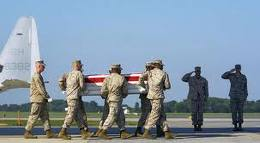
It’s been on the news and in the papers – the latest studies about our military personnel serving in Iraq and Afghanistan.
The studies done by the Pew Research Center were based on two surveys between July and September (Denver Post, Oct. 6, 2011). One survey focused on military individuals who are currently on active duty along with those who have served but are no longer active. The second survey polled over 2000 adults who had never been in the military.
What disturbed me most however was not the report that many of our troops are either “ambivalent” or do not feel the current wars in Iraq and Afghanistan were “worth the sacrifices”. Nope, what was most unsettling for me was that adults polled who had never served in the military did not give much thought to those serving in combat. Many felt that those who volunteered to serve their country knew what they were getting into.
- 84 percent of these modern-era warriors say the general American public has little or no understanding of the problems they face, with 71 percent of the public agreeing.
- Many Americans agree that since the terror attacks in the U.S., the military and their families have made more sacrifices than the general public. But even among this group, only 26 percent say this gap is “unfair,” while 70 percent say that it’s “just part of being in the military”. (msnbc.com staff and news service reports updated 10/5/2011 5:50:40 AM ET 2011-10-05T09:50:40)
I guess this last research bullet just didn’t sit well with me. Probably because as a family we have lived the aftermath of combat, lived with the ghosts of the dead and dying, and had to cope with the nightmares, anxiety attacks, and flashback memories. It isn’t that any vet or his/her family wants empathy for his/her service, but to read that 70% believe that “it’s just part of being in the military” seems like a really insensitive statement.
I am not sure that any person, young or old, has a true idea of what war and combat is about. I am pretty sure, on the other hand, that none of them had any clue that what they do, see, and experience in hell will stay with them for a lifetime. That the war they fought on foreign soils will follow them home and into their living rooms, relationships, and careers. Few of them had any clue that these things were “just part of being in the military”.
Perhaps, since Vietnam, too many Americans have been too far removed from the sacrifices of war. During WWII everyone on the home front had to give up something for the war. Now, most give up nothing, while those few who serve give up far too much. The very least we at home can do is give two or three minutes each day to say a short prayer for those and their families who serve. Just remembering our military will certainly make us, not merely better people, but a more thoughtful, compassionate nation.
Aug
29
STRENGTHENING THE X FACTOR
Filed Under Family, Spouse, Tears of a Warrior | Comments Off on STRENGTHENING THE X FACTOR
by Janet J. Seahorn, Ph.D
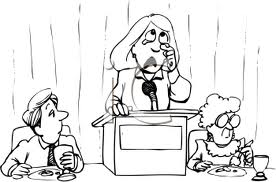
Last week I was honored by being the keynote speaker for the Women’s Luncheon at the annual Nebraska Vietnam Veteran Reunion. It is an interesting phenomenon, keynotes after eating. Most sane societies have a meal then nap for a bit. Yet, in the western world we seem to think people really want and are capable of listening to anything after ingesting a yummy luncheon. Therefore, the challenge of any meal speaker is to entertain while keeping his/her audience awake; a rather formidable task. Added to this test was the seriousness of my topic… talking about the effects of living with a spouse who is suffering with Post Traumatic Stress. Yikes!
Truthfully, this was a wonderful and unique opportunity to be with a large group of women who have endured decades of family and personal events colored by their loved one’s emotional combat trauma. The last thing I wanted was to have people leave the luncheon with more stress and upset stomachs. All of us have had way too much of these frailties. Consequently, I thought the best speech needed to be short, informative, and delivered with humor and solemnity. So here are just a few of the items I believe may be useful to strengthen the next years of these amazing women’s lives.

When I talk about the “X” Factor, it refers to what makes women, women. It is not a coincidence that women have two legs on their chromosomes to stand on versus a man’s one – “Y”. God knew we would need both legs on the “X” to stabilize us on our unforeseeable, earthly journey. Being wives, mothers, sisters… makes us caregivers and caretakers. Trauma from combat both physical and emotional makes this even more evident. “Whether it is our own mothers who stood by us in long-distance torment as we fought on foreign soil, or the mothers of the dead and wounded here as well as in Iraq and Afghanistan, we recognize that most often, it is the women—- mothers/wives… who are left to care for the broken bodies, souls, and societies left in the wake of war.”
Understanding and identifying our own actions may help protect our sanity and bodily health. Here were a few of the behaviors I asked the women to recognize and acknowledge as they interact with their loved one. Think about which of these four DOINGs you use the most:
Doing To: Blaming and Fault Finding
Doing For: Rescuing, Pampering, Becoming like the Bad Behavior
Doing NIL (nothing): Ignoring, Avoiding, Excluding, Rejecting — fuels emotions of shame in the brain
Doing With: Connecting, Clarifying, Restoring
So which category do you fall in most often? Believe me, the first three are quite easy to live in… The Doing With is much trickier to accomplish especially when you are tired, angry, and dealing with your own pain. For this reason I have adopted a powerful quote from St. Francis de Sales. I carry it in my purse. I have it on my kitchen counter, and I pasted it on my bedroom mirror.
“I made a pact with my tongue to never speak when my heart is in distress.”
Some days I am almost mute trying to practice this suggestion.
Jul
19
HEALING DAD
Filed Under Combat PTSD, Healing, PTSD, PTSD treatment, Tears of a Warrior, War | Comments Off on HEALING DAD
by Janet J. Seahorn, Ph.D

It was Father’s Day and I got to thinking about all of the vets who are fathers and all of the special moments we shared as a family, as well as the times when things weren’t all that peaceful. In our book, Tears of a Warrior, we wrote that the good things far out numbered the bad. Yet, those difficult periods left lasting wounds; wounds that still remind us of the challenges of living with Post Traumatic Stress. Healing the wounds within us and the wounds inflicted on our loved ones can be a life long endeavor – a journey that poses some questions in order to mend the injuries.
First, identify who has been wounded and who do you need to help heal, besides yourself? Which relationships have been most broken by past and/or present actions? These can be spouses, children, siblings, parents, friends, and even co-workers. Identifying your “wounded group” will require a great deal of personal self-reflection and honesty. Not something most of us humans do well. Root-canals are easier to endure than admitting we have verbally harmed someone we care about due our unhealthy behavior.
What exactly needs healing? Things like trust wounds, word wounds, responsibility wounds. What actions impaired the ability of others to trust us? What did we do that makes us question if we can trust ourselves? When have we used words to inflict hurt? Interesting things – words; they can leave wounds that are longer lasting and harder to forget or forgive than many bodily injuries. Unlike physical bruises which can be seen on the outside of our bodies, words bruise the heart in ways that can neither be seen nor easily healed.
If you have been able to get this far, the difficult question of How can I mend these wounds? emerges. It isn’t important to do something huge; start with something simple which may not be all that easy. A phone call, a letter – personally I like Hallmark cards or even the new internet e-cards can be the beginning of saying I’m sorry, or Forgive Me. PTSD has been a bit like the words Jesus used on the cross, “forgive them for they know not what they do”. Because we did not know better, it was hard to do better. Most of us had no idea what PTSD was or how living through war left the veteran with residue that impacted his/her actions for years to come. Now we can get better by knowing more about the demons of combat.
Healing others helps us heal ourselves. It is a way of living forward with hope and personal forgiveness. It may be the only way we can diminish some of the demons allowing us to lead a more productive and peaceful life. Don’t wait another day to give yourself this belated Father’s Day gift. Some who have been wounded by our actions may not be ready or able to give forgiveness. This will be their journey. You can’t force forgiveness, nor can you take responsibility for it once you have assumed ownership of your own past actions. Take a deep breath, make that first step and conquer your fears and procrastinations.
“You may be disappointed if you fail, but you are doomed if you don’t try” (William Shakespeare).
Jun
25
GOOD GRIEF
Filed Under Combat PTSD, Good Grief, Life, PTSD, Tears of a Warrior, Trauma, Veterans, War | Comments Off on GOOD GRIEF
by Janet J. Seahorn, Ph.D

Good Grief – sounds like words Charlie Brown would proclaim when something illogical occurred. When you think about it, he was not that off base using this phrase, Good Grief, because grief, at least the first phase of mourning, is anything but logical. Experiencing grief is not a rational process. It is gut wrenching and emotionally challenging. Grief by its very definition: “deep sadness or mental distress caused by loss, remorse, or bereavement” (Webster’s Dictionary) leaves the sufferer questioning if he/she will or can survive the agony.
Too many of our military men and women have had to bear the loss of friends. Yet, due to circumstances of the battlefield, they cannot take the time, energy, or effort to fully move through the grieving process. Each individual must be able to carry on without the luxury of grieving. In war, there is always another job to do, a new battle to wage, and perhaps even further loss. Add PTSD to the grief process, and the mountain to healing becomes even steeper to climb.
It is little wonder that our young and old warriors return from combat with unresolved issues. Many of these problems center around the grief process or more accurately, lack of resolving the immense weight of unsettled pain. If we were to look at the grief process described by Elizabeth Kubler-Ross’ five stages – denial, anger, bargaining, depression, and finally acceptance – it is pretty easy to identify where & why many can get permanently stuck in one phase or another. To complicate matters, real grief processing requires going in and out of the various stages for a long period, often times skipping phases only to be plunged back to that pit at a moments notice.
Families of vets often state that their loved one is in denial; denial that they are suffering, denial that there is anything wrong with them, and denial that they can handle the situation without help. Then there is anger; anger at the government who sent them to fight, anger at the enemy, anger at a civilian society that has no clue of what they went through, and most devastating is anger at themselves for not being strong enough to overcome the trauma of combat. As far as bargaining, most warriors don’t seem to bargain for much of anything except for a break to live without all of the emotional baggage.
What we see a great deal of, when and if a veteran reaches this next phase is depression. This is the phase that may be the most difficult to get through and endure without resorting to self medication. For many the moments between denial, anger, and depression can be small; often they are mixed together in a whirling mass of chaos. Achieving acceptance is seldom a permanent stage, a stage which many of our wounded warriors never attain even for brief moments.
Dealing with Post Traumatic Stress is dealing with grief. It is not easy; it is not quick; it definitely is not logical; and it is not a journey that any one of us should have to go through alone. Is there such a thing as Good Grief? Truthfully, I am not sure any grief is good, but I have witnessed and have personally gone through mourning that is doable. To be perfectly honest, I am not sure grief made me stronger, but it certainly made me more compassionate and gave me a deeper appreciation of each ordinary day where I can breathe freely without feeling my heart breaking.
And that in and of itself is pretty darn GOOD.
Jun
17
LIVING STORIES
Filed Under Combat PTSD, Life, PTSD, Tears of a Warrior, Trauma, Treating PTSD, Veterans, War | Comments Off on LIVING STORIES

It came in the mail, a book from a professor at Eastern Kentucky University, The Journal of Military Experience. Most publications I get from universities are on topics that deal with academia, you know – ways to teach literacy, how the brain works, and other research topics. This book was different. It wasn’t written by a bunch of stuffy professors based on their special investigative studies. Nope, this book was written by a group of young veterans who had served overseas and were trying to reintegrate into civilian and academic life. Needless to say, many of the stories and poems were composed with emotions that were still raw from combat.
The authors were students in Professor Travis Martin’s writing class. The purpose of his unique course was to help with the initial assimilation phase of university life. “Some of the authors write about the unspeakable things that they have been asked to do, or more accurately, that have been done to them. But some focus solely on that work of translation, making sense of a warrior culture and the mentality of an individual who has been bred, trained, and conditioned by a society in desperate need of a few willing to sacrifice for the many (Introduction).”
The theme in many pieces confirmed how challenging returning from war was for these young warriors. They wrote about who they were before combat and how they had changed from the experience. How seeing friends die before their eyes, how being shot at on a regular basis, how tough it was to determine who would live or perish depending on their interpretation of an approaching car or a family on the side of the road, how these battle experiences made their time during and after conflict more demanding. One marine described “every day someone else would die or get seriously injured. One of my friends lost his legs from a roadside bomb right outside our front gate at 0200 in the morning (Guy Robert Lubin, p. 6-7)”.
Yet, in spite of all of the horror, all the wounds both physical and emotional, not one individual regretted serving his country. Not one person wished he/she did not complete a tour of duty overseas. What some did question, though, was when or if they would ever be free from the fiends of warfare. One author acknowledged “you truly stop caring. You don’t want to shoot, but you will. You won’t think about it, until you get home that is (Bradley Johnson, p. 53)”. He continued, “While you fight and suffer and struggle, you are also changing, becoming someone totally different. The harsh and violent realities of war forces you to change. Emotions are an inconvenience — they distract you — making you feel and think instead of react. A distracted soldier is a dead soldier. My evolution was a great thing on the battlefield, but it is just as much a bad thing when you get home (p. 53)”.
In this book, there are profound words and stories from those few who have given so much for freedom in our country and lands far away. They are “living stories” from real warriors. They ask nothing but a smidgen of understanding and a bit of healing when they return. For every vet past, present or future let us value the sacrifice and honor the service never failing to remember how all gave some, while some gave all.