BOOK PURCHASE: Discount (above) or PayPal (below)
Click "Buy Now" to continue to PayPal
Click to order eBook - Kindle

Click to order eBook - Nook

Apr
29
Courage Revealed
Filed Under American Patriotism, Bless Our Troops, Combat PTSD, Courage, Dogs, Military, Post-Traumatic Stress "Injury", PTSD, Service Dogs, Tears of a Warrior, Trauma, Veterans, War Dogs, Wounded Warriors | Comments Off on Courage Revealed
by Janet J. Seahorn, Ph.D

It is easy to see what courage looks like. We observe it in the acts of those who, in spite of intense danger or inconceivable suffering, or endless determination, an individual continues to live on. To move forward. We see it in the movies where it makes us feel safe and in control in events we know we may never survive.
But what does courage sound like? Does it reveal itself in words, in songs, in other types of media? Perhaps real courage sounds like Silence. The silence of grief that cannot be expressed in words. The silence of a heart being shattered. The silence of hidden tears and silent screams.

And what does courage feel like? It may be different for every person, yet, individually it contains some singular similarities. Our feelings, much like hearing, is silent beyond ourselves. Emotions, an element of feelings, come at anytime, day or night. It cannot be quantified, perhaps because we may not be able to find a beginning or end in its infinitesimal existence. You see, feelings go beyond emotions. They are deeper, often jumbled together with anger, love, gratitude and sadness. We feel what we feel. Attempting to put feelings into words can be exhausting, exasperating, and mostly ineffective.
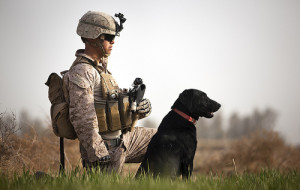
Courage, like feelings and hearing is also Silent. It is very much present. There is both a sweetness and bitterness in courage. The sweetness of living through a reality that many may never experience. The bitterness resulting from that very same experience. It is not about the “why me”, “how come”, or “what ifs” of suffering. Simply having the courage to accept the experience for what it is— an experience that changes a person from the before to the now – and beyond.

We spend too much time trying to define/identify courage. Most results are superficial at best. For if, as I believe, courage is found only in the Silence… the empty spaces between the noise and what is seen, heard, and felt. We often miss or mistakenly identify courage. Its potential seed lives in most of us, yet, it can only be germinated when or if the time presents itself. For some of you reading this piece may think, “What the heck is she rambling about?” For others, those who have lived the courage, you may only nod your head and silently say “true”.
Mar
23
TED TALKS AND PTSD
Filed Under Brain Injury, Dogs, Post-Traumatic Stress "Injury", PTSD, PTSD treatment, Service Dogs, TBI & PTSD, Tears of a Warrior, TED Talk, Vietnam Today, Wounded Warriors | Comments Off on TED TALKS AND PTSD
By Janet J. Seahorn, Ph.D
 TED (Technology, Entertainment, Design) is a global set of conferences run by the private non-profit Sapling Foundation, under the slogan “Ideas Worth Spreading”.
 It continues to be an overly busy few months. We are waiting for things to slow down a bit, yet, as soon as we are done with one “To Do List” another pops up with an even bigger task sheet. It begs the question as to whether we are really that harried, or if we are more easily exhausted because we aren’t all that youthful any more. OK, don’t go to that disheartening place.
 A few weeks ago, I had the opportunity to do a TED Talk at Colorado State University where I’m a professor in the Education College. Of course my topic was Post Traumatic Stress. After months of putting together the talk and multiple practice sessions, the day finally arrived. Truthfully, when I was first accepted as a speaker I was quite excited. As the day for the TED event grew closer I became more anxious. It wasn’t the fear of talking in front of large groups of people – we do that often. It was trying to fit twenty years of research and essential information into a fifteen minute timeframe that drove me to panic. This was more like the old television show, Name That Tune, in which the contestant was given only the first three or four notes of a song and expected to know its name; a seemingly impossible task for discussing Post Traumatic Stress and its effects on the brain, body, and spirit.
 As I entered the stage area I felt like Katniss from the Hunger Games, going into a life and death battle without the proper equipment. You will have to listen to the talk (the information is in this blog), to see the results. Be sure to go to watch the very end for a surprise appearance of our service dog, Bailey. Tony, unbeknownst to me, brought him to the event and sent him up on stage at the very end of my talk. OMG!!!!
Ted Talk: 15 minutes worth hearing!
Understanding PTSD’s Effects on Brain, Body, and Emotions | Janet Seahorn | TEDxCSU – YouTube
https://m.youtube.com/watch?v=BEHDQeIRTgs
Jan
5
Thank You!
Filed Under Bless Our Troops, Christmas, Combat PTSD, Dogs, Holiday Season, New Year, PTSD, Tears of a Warrior, Trauma, Veterans, War, Welcome Home, Wounded Warriors | Comments Off on Thank You!
WELCOME BACK!
by John DiCiacco – Guest Blog (John is a veteran & brother who helps make a difference)
I can’t speak for every person who reads your blogs, but I can and will say this, I have missed not reading them. The only thing that ever depressed me was the first paragraph in your latest blog. You always come up with something that touches someone, whether it be thought provoking or light hearted.
Your words always mean something to someone. Blogs can and should present different topics and when folks consider one to be difficult to read, then they can choose not to read it. But don’t just complain to the author, because life isn’t always a bowl of cherries.
As we all know, you can’t be everything to everyone so don’t try. But please don’t stop writing your blogs. Take it from this Veteran, I have never read a single one of your blogs that made me feel depressed. You write about reality, especially meaningful to veterans and families who suffer from the wounds of war.
I know that some times during any given month you have your own personal traumatic experiences that make life a little difficult and so you do your best to just survive. Just like the Veterans whom read your blogs. When moments arrive that you can’t seem to come up with something to talk about, I can assure you that I do. Or have a Request Button on Note asking the readers if they have something that they would like to talk about through you.
Oh, by the way, your ticket into Heaven has already been secured. Your Ancestors and Guardian Spirits have made sure of that.
As you know, I spent two tours in the Nam and Holiday’s are still very hard for me. Too many Ghosts and way too much guilt for one man to carry. The haunting reality for many Combat Veterans is the same unhealthy thought pattern we carry and wear on our chests like a sort of Medal. That thought is this and I quote: “Why in the hell am I here and not so and so”, or “I don’t have the right to celebrate or be happy when so many of my Brothers will never be here.” Most Veteran’s never come right out and say these things but the thoughts are real and they and their fallen Comrades are there as well.
Of course, in my efforts to be jolly I would have to self medicate and numb the pain just to get through the ordeal. Afterword the Guilt followed by the shame for drinking was much worse.
I don’t know how I got on all of this but I better stop.
You can blog me anytime you want.
Dec
24
Having a Happy Holiday
Filed Under American Patriotism, Bless Our Troops, Christmas, Family, Healing, Holiday Season, Journey, PTSD, Tears of a Warrior, Veterans, War | Comments Off on Having a Happy Holiday
by Janet J. Seahorn, Ph.D

It has been several months since I wrote the last blog. Honestly, I chalk it up to lack of motivation and simply feeling I had little else to say that would be worth anyone taking the time to read. Some individuals even commented on how many of the past blogs were a bit depressing. No kidding! Many of these individuals may have never had the combat experience or served in the military. It is difficult to understand something that has not been experienced. Humor at times can be difficult, especially during the holidays when you live with a person suffering with Post Trauma Stress. The experience is so not funny.
Yelling at those who don’t seem to appreciate or understand this type of suffering would definitely be something I’d have to mention in my next visit to church and confession. Just hope it might be a different priest who won’t say something like…. “Well, seems like you haven’t made much progress in this area”.
At this point my entry into heaven would be further compromised. At the very least I would be on Santa’s naughty list.
So, why am I writing a new blog now? Because it is Christmas. My favorite holiday (along with Easter, Thanksgiving, Valentine’s Day…). Really, I love the smell of the season, the food, the lights in and outside of homes, carols, and the various displays around town. Unfortunately, as much as I love Christmas, I am reminded of how many of our veterans find this particular time of year a huge challenge. Christmas may be an unpleasant reminder of all that was lost – those who never returned home and those still serving in harm’s way far from home. Depression, anger, feeling alone and removed could be emotions that have to be dealt with once again. It is hard to be jolly or even be around those who are jolly when you are fighting to just keep your head above the waters of Merriment.

Tonight Tony was talking on the phone with a friend and veteran who was facing another season of cheer and trying to simply get through it and keeping his emotions/temper in check. During the conversation Tony mentioned that it was this time of year when he was in Vietnam and severely wounded. He lost many of his men during a horrendous battle and later spent months in various military hospitals trying to heal from his injuries. All these decades later it is not the physical wounds that test him the most. It is the emotional aches that make the holiday season taxing. Instead of all the Ho, Ho, Ho,….. I know that certain days he wants to scream, No, No, No More!!!
For years I had no idea of what he faced or continued to face. My delight during this time of year only exacerbated his loss thus causing more than one argument. Now that we both know better, we finally do better. I try to be a bit calmer in front of him, and he tries to take better care of his emotional needs by having more quiet time, going on long walks or taking Bailey pheasant hunting. And both of us focus on counting our blessings.
We’ll be darned if we let the PTS Grinch steal Christmas ever again.



Mar
18
How you can honor our Vietnam vets
Filed Under Combat PTSD, Peace, PTSD, Tears of a Warrior, Troops, Veterans, Vietnam Veterans, War | Comments Off on How you can honor our Vietnam vets
Ann McFeatters: How you can honor our Vietnam vets
Guest Post from the Dallas Morning News:
By ANN MCFEATTERS
Published: 05 March 2015 07:27 PM
The man who said his name was Danny arrived at my door with a huge floral box. Inside was one of the most beautiful bouquets I’d ever seen.
Danny was with the Maryland highway department, supervising a crew installing new curbs on my street. He was also a Vietnam veteran who had seen the small blue star in my window, indicating two family members were serving in Iraq and Afghanistan.
Danny came from a generation that provided 9.2 million people who served in the military during the Vietnam era, many of whom came home from war reviled, not thanked for what they gave their country. Like most of his fellow veterans, Danny vowed to show only gratitude to those in military service, no matter what the politics of any current war that service members are called on to fight. Flowers to a stranger were to thank my family.
This month marks the 50th anniversary of the arrival of 3,500 Marines in Da Nang, South Vietnam, beginning 10 years of a terrible conflict that would sear and scar this nation.
In the “lessons learned” department, perhaps the most important is to separate the warrior from the war. Today Americans of all political stripes express sincere appreciation for what the men and women of the armed forces are called on to do for their country, whether the mission is popular or not.
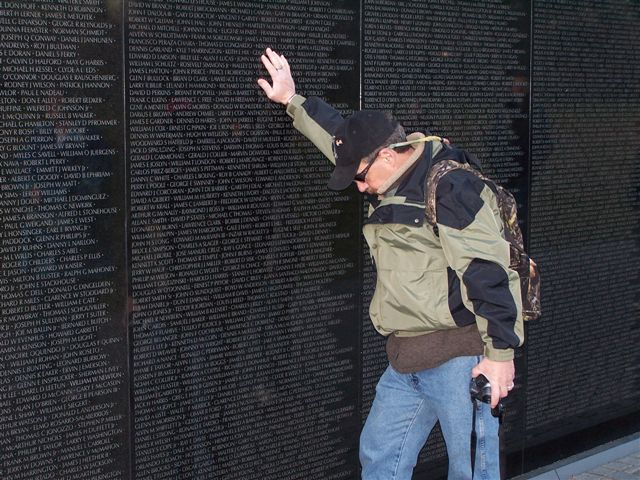
The Vietnam Veterans Memorial on the mall in the nation’s capital, with its awesome wall designed by Maya Lin, engraved with the names of 58,300 people who gave their lives in the jungles of Southeast Asia, was meant as one way toward healing a divided, bitter country.
It has worked. The three-acre memorial with its gardens, wall, Vietnam Women’s Memorial and The Three Servicemen statue, is visited by 4.5 million people a year. Its website, with photos and information on veterans and messages from their friends and families, draws 4 million virtual visitors annually.
The veteran behind the memorial, Jan Scruggs, a man of enormous personality and drive who raised the $8 million needed to begin implementation of it, is retiring this year.
One way the Vietnam Veterans Memorial Fund plans to honor him and all the war’s veterans is to raise money for a $116 million underground education center to display some of the 400,000 personal items left at the wall by visitors, a unique occurrence which stunned the memorial’s founders.
From teddy bears to tear-stained letters, the items, stored in boxes maintained by the National Park Service, which owns the memorial, tell powerful stories.
Approved by Congress with no funding, the education center needs donations from the public if it is to be ready for a ribbon-cutting ceremony in 2020. Most of all, the Vietnam Veterans Memorial Fund wants future generations to learn about the Vietnam era, how decisions were made and what they meant to the nation.
Tomorrow’s fifth-graders must learn they owe a debt to those who came before them and that they, too, must leave a legacy of service, the best way they are able. Technology will give them access to such things as digital oral histories from veterans and TV footage of the first war played out in the nation’s living rooms.
There are 7 million living Vietnam War veterans. Beyond those who died or went missing there, Vietnam veterans are still dying of injuries sustained in the war, such as exposure to Agent Orange and post-traumatic stress disorder. The fund’s CEO, Jim Knotts, a Desert Storm veteran, stresses that these veterans must be honored, and that good health care for all veterans must be a national priority.
Because of space restrictions, the education center will be the last major memorial built on the National Mall. Fifty years after the start of the Vietnam War, it is time to take the next step in honoring those who fought it, whether they wanted to or not.
Here’s to you, Danny, and all those like you.
Mar
7
FIFTY SHADES OF PTS(D)
Filed Under Combat PTSD, Fifty Shades, PTSD, Tears, Tears of a Warrior | Comments Off on FIFTY SHADES OF PTS(D)
by Janet J. Seahorn, Ph.D

The big movie (at least for many women) seems to be Fifty Shades of Grey. Not having read the three book series or gone to the show (as of yetJ) I decided to check with my sister who has read all three. As she described the main character, a Mr. Grey, I asked her to tell me about the number “Fifty”. What the “Fifty” supposedly refers to is what I expected…. Fifty shades of one’s personality, including some erotic sexual preferences. Now I probably have some of your attention…
Yet, it is what she explained after my title question that was most intriguing. You see, Mr. Grey, being a brilliant, wealthy, handsome billionaire had a pretty troubling childhood. That early experience made him more than a little narcissistic and unable to have true, intimate relationships and feelings for others. What Mr. Grey displayed in his life and personality is what we all fall into, albeit, in different scenarios and reasons. So here is where we all can relate to the Fifty Shades of Me or Fifty Shades of Post-Traumatic Stress.

Each shade of ourselves is colored by the time, place, situation, and prior experiences of our lives. When we are calm and things in our daily lives are going well we are in that green, blue, maybe even lovely lavender zone. If the triggers are under control and the demons are taking a short nap, we are content, happy, and can go about our world looking fairly normal.
It is when all the crap hits the internal emotional “fan” that the colors of ourselves can change – pretty drastically and swiftly. When our triggers are on edge from prior traumatic experiences, our emotive colors display very bright shades of crimson, reds, oranges, yellow… The many hues of these shades have a huge impact on how we internalize the external world and all of its inhabitants and barriers.
In Post-Traumatic Stress, the weaver and tapestry are even more complex. There is no one way, right way, or best way to experience trauma and its aftermath. There is no singular impact that is 100% the same for each person’s prior experiences. Individual experience will shape the impact and actions of the trauma.

The only thing that remains similar for most individuals is the anguish and uncertainty of how long the emotional pain will last.
Remember the adage, “What one resists, persists”. Dealing with intense emotions that have shaken one’s very core takes time to heal.

Our personalities contain many different colors and various shades of each. Like Joseph’s Amazing Colored Coat, we too wear an array of colors depending on what is transpiring in our lives both past and present. Our coat of many colors, our Fifty Shades of who we are came from each experience of life. The colors represent the tapestry of our history, our individuality, our temperament.

A multicolored life is far more interesting than a bland, one color existence. However, to display these beautiful, brilliant colors, we have to be unafraid to live each day with the courage to recognize we are clothed based on our experience.
Therefore, celebrate your fifty shades of who you are…. You earned each and every one of them.

Jan
22
PUPPY LOVE AND CRAZINESS
Filed Under Dogs, Pets, PTSD, Service Dogs, Tears, Tears of a Warrior, Wounded Warriors | Comments Off on PUPPY LOVE AND CRAZINESS
by Janet J. Seahorn, Ph.D
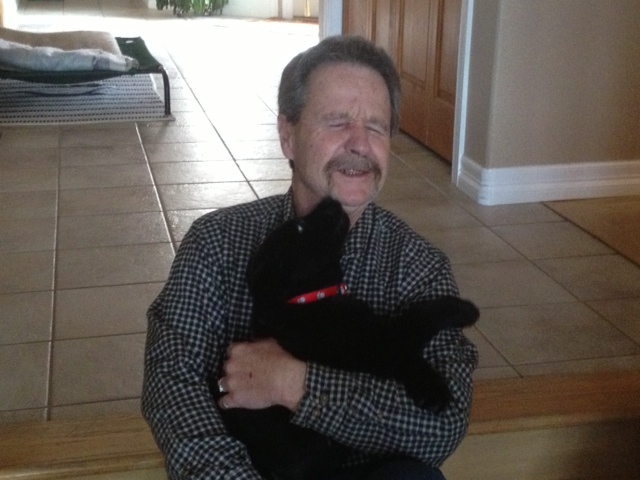
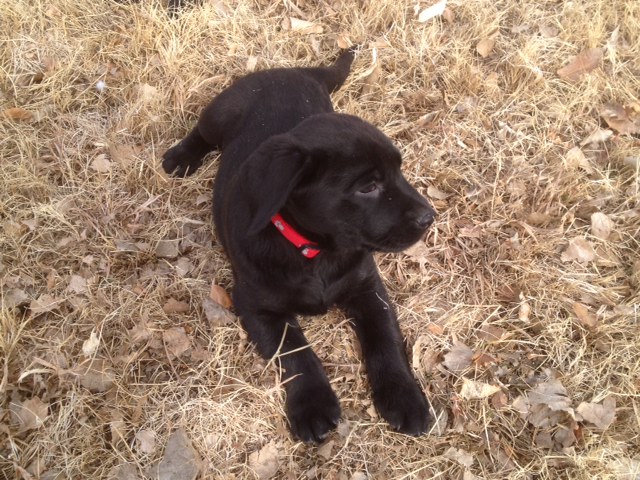
So you think you want to bring home a new puppy. You know, one of those wiggly, darling, sweet looking bundles of joy. They appear amazing innocent in the entire plethora of internet pictures, advertisements, and billboards. Yep, you definitely believe one of these adorable, four-legged, loveable, furry cherubs known as “man’s best friend” will enhance your life and look great on your next Christmas card. And, you aren’t totally oblivious of what it might take to raise one of these creatures. You’ve had puppies before, of course. You may have been much younger and more patient at the time.
You understand that this energetic whippersnapper will take a pretty good amount of time to potty train, learn new commands, and not bolt at the first slight opening of every door in your home. Hiding any and every item that might go into the puppy’s mouth including expensive eye glasses could end in an inflated doggy hospital visit – sure to cost you an arm and a leg. This will be essential to your pocket book and your endearing, four-legged child’s health. Oh, and did I mention how much puppies love the leather seats of your new truck’s interior.
If your adorable, small creature is going to grow into a huge, muscle bound tank, like my brother’s black lab, Mato, life becomes even more fun to control. Things like not allowing this boiler of energy to greet others, especially children and the elderly, by approaching them like a freight train and jumping full force onto their chests. This will be crucial to avoid unpleasant verbal encounters or even law suits. Of course that once tiny bundle of fur has no clue that he has grown into a ninety pound bruiser of a beast.

Oh, and don’t forget that if you have other household pets, bringing a new four-legged nipper into the pack will require an immense amount of patience, both for you and your other domestic companion. My brother, John, wanted to have another pal for his aging lab, Wyatt. We did something similar with our beloved older lab, Chase, when we brought Hunter Bailey into our abode, and told John, how Bailey helped bring new life back to Chase’s daily routines. It actually, we believed, gave Chase a new lease on life and kept him agile and healthy for several more years. To be honest, Chase did not fully support this perspective. Bailey, however, kept Chase’s competitive spirit active. Chase would not allow his new “buddy” to ever get an edge on any ball, bird, or swimming event.

However, in our limited experience we forgot one significant point. Just like kids, all dogs are not alike, and Mato (Lakota for Bear) was absolutely not like Bailey. Bailey, as the younger dog, was quiet, subservient, and a fairly mild lab compared to when we raised Chase. Chase was more like Mato, impulsive exhaustingly active, and stubborn as hell. My brother’s older dog, Wyatt, has always been a gentle people pleaser, more like Bailey. Poor, innocent Wyatt had no clue what a new puppy would bring to his world.
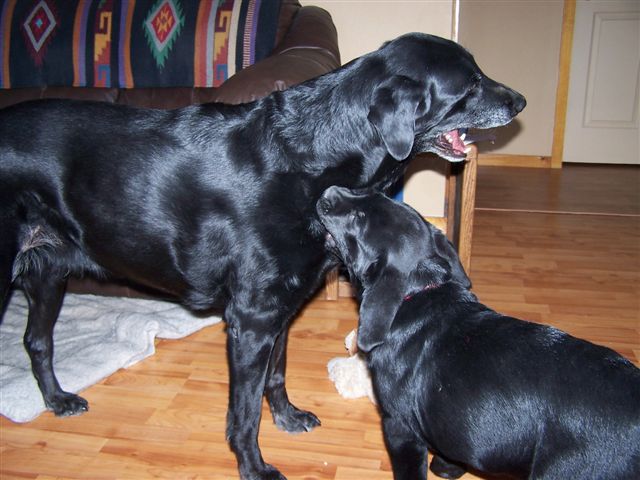
Today, Wyatt has extreme doggie PTSD from his adopted brother, Mato. Having a huge puppy leaping on him throughout the day, pulling on his ears and legs to induce play, or taking more than one dog’s share of food would be traumatic for any aging canine.
So, what does this story have to do with Post Traumatic Stress of an aging military veteran, one might ask? Bringing a new puppy into your quiet, tranquil home may generate more stress and anxiety than you ever imagined. Just ask my brother, John. He now refers to his beloved puppy, Mato, as a Weapon of Mass Destruction. Need I say more…
Nov
13
SALUTING HEROS
Filed Under American Patriotism, Combat PTSD, Peace, PTSD, Service Dogs, Tears, Tears of a Warrior, Veteran's Day, Wounded Warriors | Comments Off on SALUTING HEROS
by Janet J. Seahorn, Ph.D
If you have never been to Lubbock, Texas it is a flat, dry, and very youngAmericanCity. It was founded in 1911 which was a bit surprising considering that today it is home to around 250 thousand people as well as the well-knownTexasTechUniversity. TTU has the largest campus of any university in the United States and an attendance of close to 35,000 students. There are few places one can go where they don’t see some logo or item related to the Red Raiders. I must admit I really liked their black, red, and gray colors…. a very classy look for their entire plethora of apparel, knick-knacks, jewelry, poster, etc. Texas Tech is also home to the largest Vietnam archives in the world. People from anywhere in the world can access their files through internet with little or no cost.
However, here is what impressed us the most about the university and its personnel, it is a very veteran friendly campus and tries to honor its veterans and their families every day. Last week, before Veteran’s Day, it hosted a four day event celebrating veterans and families. On Wednesday they oversaw their first Veteran’sSummit. It was a day of learning about the challenges of returning from war and transitioning into a community where less than one percent of the population has been fighting the last ten years in Iraq and Afghanistan. Various professionals, including Tony and I, spoke of the difficulties of living with Post Traumatic Stress and Traumatic Brain Injuries. A doctor addressed the complexities of vision problems veterans face. Several veterans, including a panel of four young men who served in Iraq and Afghanistan, shared their experiences in combat and how that impacted their ability to reintegrate back into their families and neighborhoods. Their stories were both heartbreaking and informative. COL David Lewis shared what Lubbock is doing for veterans along with how essential it is for every community to have a Veteran’s Court that deals with those who find themselves involved with actions that landed them in jail or mental health facilities.
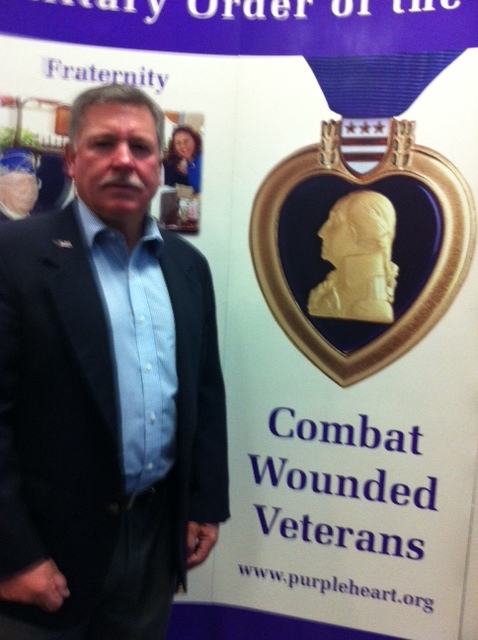
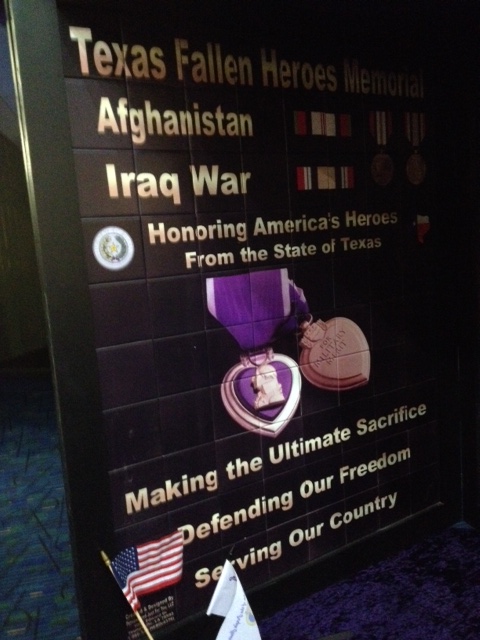
Friday evening, the community and university put on a banquet for Purple Heart Recipients and their families. Several Gold Star families (those who have lost loved ones) were part of the event and Medal of Honor Recipient, Doc Ballard fromKansas City, was the Keynote Speaker.
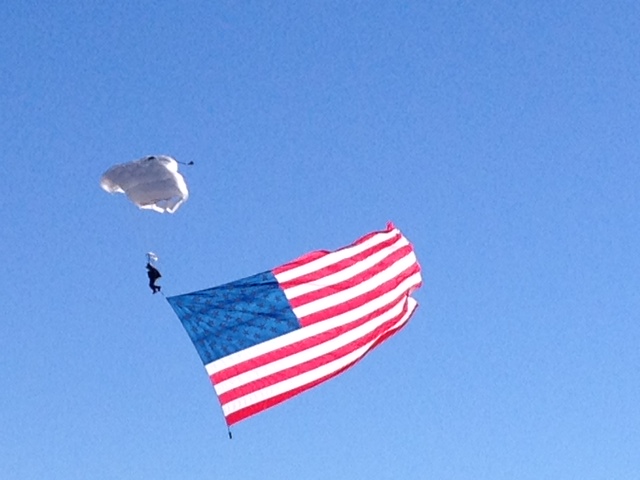
One of the most remarkable parts of the four day events was when almost 500 Purple Heart Recipients were treated to the Texas Tech football game. Before the game began, paratroopers floated into the stadium with Old Glory flying behind them. One of the jumpers was Dana Bowman, a veteran who had lost both legs in a fatal skydiving demonstration in 2001. His courage is a testament to how incredibly resilient our men and women in military are when they are in combat and even more so when they return. As he stated in his speech, “It is not the disability, it is the ability” that matters.
For most Americans who have never had to fight for our precious Freedom few realize – especially our young population – what it is to live without Freedom. We must all guard against complacency and never take for granted the gift that each American has been given because of the service of our military. God Bless our armed forces and our many veterans and their families. Freedom is never free. Let’s support and heal all of our veterans every day of every year, not just honor them one day a year. It is the least we can do.
Jul
12
CHASE’S MEADOW
Filed Under Aging, Dogs, Family, Fishing Therapy, Healing Waters, Journey, Life, Love, Peace, Pets, PTSD, Service Dogs, Tears of a Warrior, Tears of Joy, Veterans | Comments Off on CHASE’S MEADOW
by Tony & Janet Seahorn

The human heart and mind are amazing in their capacity to experience intense sadness and abundant gratitude at the same time. That lump in the throat is still there as are the tears that cloud my eyes. Yet, the weight of the death of our wonderful Chase seems to be a bit lighter.
Earlier this week, we visited Chase’s most beloved mountain meadow, high on the Snowy Range in southern Wyoming. It is a beautiful, alpine meadow filled with wild flowers and a running brook. This is the place we chose to spread his ashes and place a stone memorial on a wooded ridge overlooking the peaceful valley below.
We promised to make this journey after the early summer snow melt and before the wildflowers were in full bloom.
His very essence now glides in the winds and rolls gently with the flowing water. White and yellow flowers line his final path. He is at peace, as are we. And younger brother Bailey still romps through the brightly colored grasses chasing after his cherished tennis ball – a reminder that joy is always present around and within our souls.
As we paid our final respects it seemed as if Chase was giving us his final message:

I am now in my meadow; my ashes white as angels’ wings float with the Wind and flow through the mountain streams to places I never ran in life.
Peace and beauty will always surround me with a green and white and purple blanket of sweet columbines.
This is where I was finally meant to be.
Therefore, honor me not with tears of sadness, but with hearts of joyfulness.
Remember me with stories and laughter.
And most of all know that as much as you loved me I loved you even more.


Black Forest Chase
April 23, 1999 – January 4, 2013

Jun
25
FIELD OF HONOR
Filed Under Field of Honor, Flag Day, PTSD, Tears of a Warrior, Veterans, Wounded Warriors | Comments Off on FIELD OF HONOR
by Janet J. Seahorn, Ph.D

One thousand, full sized, American flags flew on a grassy green, long rolling boulevard in Cody, Wyoming.
It was their second annual Field of Honor Flag Day. Each flag was purchased on someone’s behalf. Sometimes it was for a family member who had served in the military. Some flags were given in honor of a special friend. And some were purchased to show respect and gratitude to an organization or group who has made a difference in their community. At any rate, up until this event, I have never seen so many large flags jam-packed in one place. Quite an impressive sight for these timeworn eyes.
This vista reminded me of a saying by Sara Teasdale, “My soul is a broken field, plowed by pain”. This field was created to honor those who sacrificed so much for their country, their communities, and their fellow Americans. Each flag was a tangible reminder of the broken souls, bodies, and hearts impacted by wars old and new. We brought two flags, one to commemorate an uncle who I had never met who died in WWII as part of Patton’s assault in Normandy; the other was to pay tribute to Tony and all those who served in Vietnam.

What made this a wonderful event were the charming individuals who attended the four days of celebrations. Much like the Vietnam Wall experience, many visited the Field of Honor to pay their respect, to view the sight of these amazing flags sometimes pounded ruthlessly by the heavy winds of Wyoming. There were times when some of us wondered if they would sustain such severe gusts. Yet, they did, every day, every night, and every gale. Several of the individuals we met were like the flags, tough, reliable, and persistent.
One veteran, John, was a ninety year old man who served in WWII in Africa, then Korea, and finally Vietnam. After our presentation he stated he would once again be visited by nightmares and visions from his past war conflicts. “They never seem to go away”, he declared, “and continually find their way into my thoughts and dreams.” The second individual, I watched from our position as guest speakers. He was a young man bouncing around a very small baby who couldn’t be more than a month old. After placing his tiny package into a near-by stroller, he just stood there, listening and watching. Shortly after our talk, I walked over to where he was standing and asked if he was a veteran. “Yes”, he responded. He had served several tours in combat. Much like the stories I told of a few of my university students who tried to return to school after war, he also dropped out, unable to withstand the innocence of a campus youth who have never been exposed to war’s trauma. Now he was in the process of reorganizing his life as a new father/husband, and finding a fulfilling purpose for his life. A life that he will have to fight for in order to live fully. A life with struggles. Much like his combat encounters, he will have to accept and move forward. A life with some sorrows that must be endured. And a life created with his special song that must be sung with great passion.

So here is wishing peace to all the John’s that went through too many battles and still struggle with their demons after such a very long time. And for all the young Patrick’s who are composing their own unique melodies.
May their ballads be full of love, laughter, and happiness.

